Collapsed wastewater lines in Greenwood could put a strain on the city’s budget this fiscal year as it deals with the effects of the COVID-19 pandemic and other issues.
The city has been dealing with a number of caved-in wastewater lines since late December. In each case, the City Council has declared an emergency to get the line fixed. The city’s current fiscal year began Oct. 1, 2019, and runs through Sept. 30, 2020.
The city’s most recent cave-in, which involved a 24-inch stormwater line and was discovered last week, is located near the old fire station building along East Claiborne Avenue.
The council declared an emergency Tuesday to begin the process of fixing the cave-in. Eddie Curry, the director of the city’s wastewater division, said Wednesday that the city is still working on what to do next.
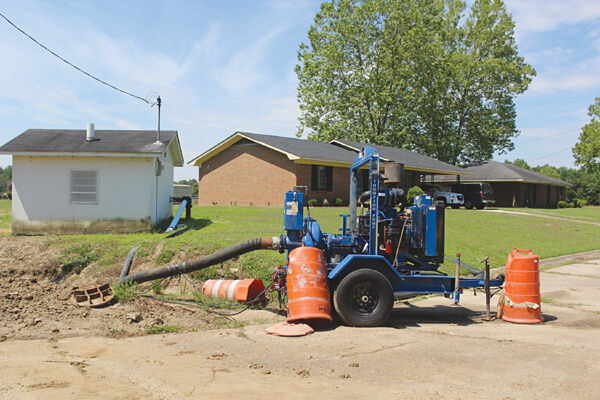 A pump is at the intersection of Twin Lakes Boulevard and Valley Drive. In late December, a sewage line in the area collapsed.
On Dec. 30, a sewage line running through Twin Lakes Boulevard and Valley Drive collapsed. Bypass pumps have since been installed on site, though Curry said the city won’t be able to put in a new line until the groundwater recedes.
On Feb. 24, the city declared an emergency for the collapse of a wastewater line across the levee along the 600 block of East Claiborne Avenue.
Water from the Yazoo River poured into the cave-in, causing river water to enter the city’s pumping station on Ione Street. Additionally, untreated wastewater was discharged into the river, according to the Mississippi Department of Environmental Quality.
MDEQ issued an advisory to stay clear of the Tallahatchie River from Money Road and the northern section of Grand Boulevard all the way downstream on the Yazoo to the Roebuck Road bridge, which is on County Road 512 in the southern part of the Rising Sun community. Robbie Wilbur of MDEQ said the advisories for the affected parts of the rivers are still in effect.
Curry said the city has been able to plug the hole and complete the necessary repairs.
On April 7, the city declared an emergency after a sewage line at the intersection of Weightman Street and Park Avenue collapsed, forming a hole in the center of the two streets.
Curry said the cave-in and the sewage line have been fixed.
Mayor Carolyn McAdams could not give an estimate of how much each caved-in line costs but said the city will have an accountant run a quick audit through the wastewater fund, where expenses for cave-ins and new lines have been deducted, to come up with a figure.
The city’s wastewater fund for the current fiscal year was budgeted at $6.2 million when the council voted to adopt the city’s budget in September.
McAdams did say that the repairs needed for a sewage line that collapsed last August on Ione Street, in front of the former site of the Leflore County Humane Society’s animal shelter, cost the city between $1.3 million and
$1.5 million.
If necessary, money from the city’s general fund budget could be used to help fix the caved-in lines, the mayor
said.
The heavy rain and flooding the city received earlier this year and last year, as well as the age of the pipes, could be reasons for the collapses, the mayor said.
Separately, the city is dealing with the effects of the coronavirus pandemic.
The city has spent at least $38,000 in COVID-19 prevention and preparation efforts, the mayor had said, citing a number that applied several weeks ago.
Recently, the city was awarded $37,307 in coronavirus relief money from the U.S. Department of Justice’s Bureau of Justice Assistance. However, McAdams has expressed concern several times that the city is likely to see a decrease in revenue from sales tax collections since the operations of Greenwood businesses have been affected by the pandemic.
• Contact Gerard Edic at 581-7239 or gedic@gwcommonwealth.com.


