Driving across any of Greenwood’s bridges this week, a glance at the river banks might make it look as if the city is about to go under water.
Not so, say the U.S. Army Corps of Engineers and local officials who make it their business to regulate water levels.
A dire weather forecast might damper that confidence but, as things stand now, the National Weather Service is predicting the possibility of just 1 more inch of rain in the next 24 hours on top of the .75 inch that fell overnight.
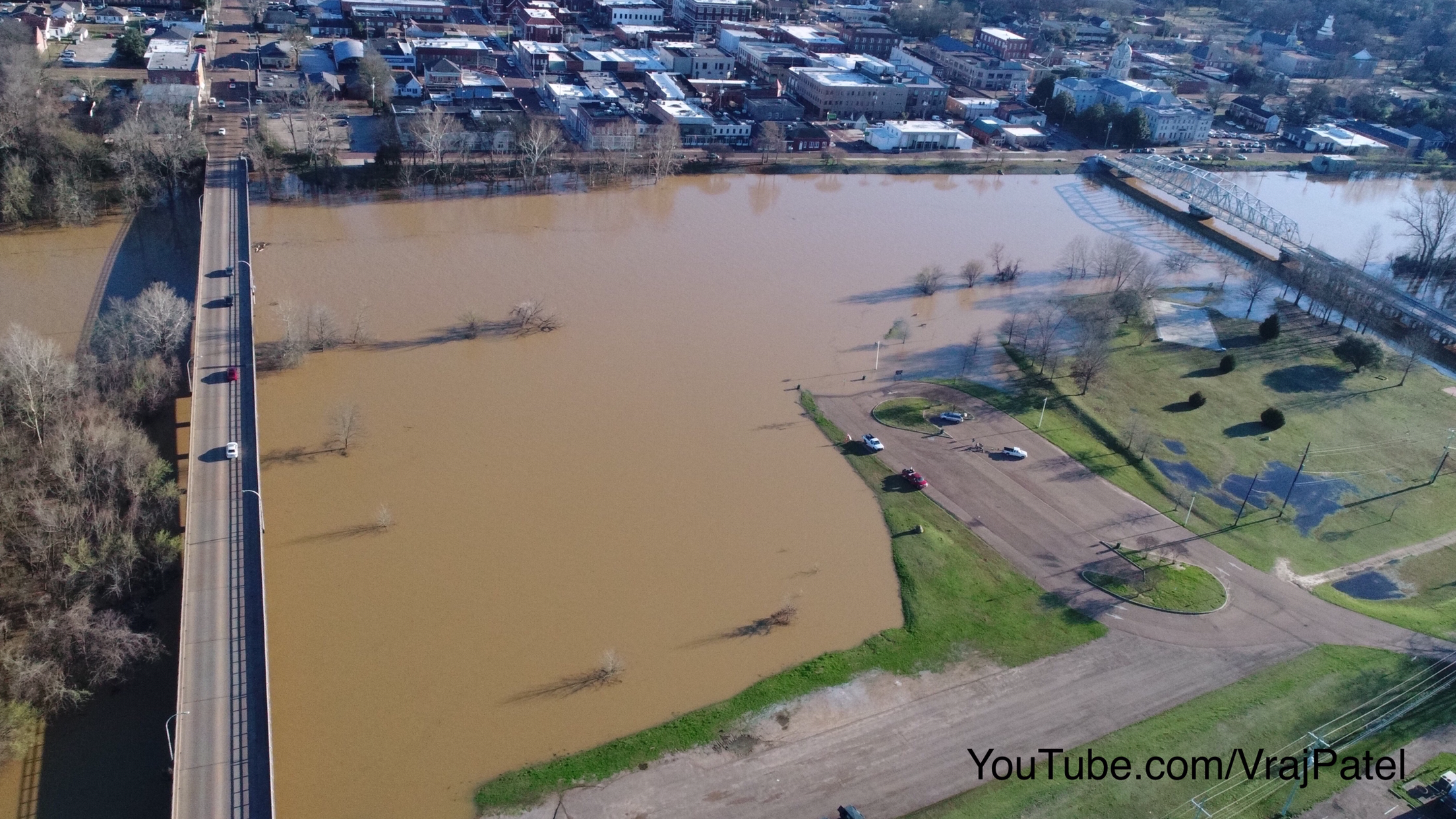 An aerial view of the Yazoo River at the Veterans Bridge shows the river well out its banks on the north side, covering what is normally park land. The lines visible in this photo are exposed tops of mature trees.
Beyond that, meteorologist Alan Campbell said, the community can expect a nice three-day drying-out period before the next weather system moves in on Sunday night.
Meanwhile, the Yalobusha River is out of its banks in the northern part of the county, the Yazoo River has crept up over the Yazoo River Trail and the city arboretum between the Keesler and Veterans Bridges, and the Tallahatchie River is about twice as wide as normal.
Basically, it’s a good thing a huge rain is not in the forecast because, at this point, there’s nowhere for the water to go.
District 1 Leflore County Supervisor Sam Abraham said the culverts that normally carry wastewater into the rivers are submerged, so both the city and county are relying on pumps to carry water overflow across the levees into the rivers.
Particular attention is being paid to ditches in the city and county, which need to remain free flowing and unclogged to avoid backup of rain into streets and neighborhoods, a perpetual problem said Mayor Carolyn McAdams.
“People use the ditches to put their trash in – yard waste, bagged and unbagged, tires, all kinds of stuff that clog up the ditches causing overflow,” McAdams said.
“This week all our public works people have done is clean out ditches. You wouldn’t believe what we find in them.”
Abraham said clogged ditches are a problem in the county as well, sometimes leading to damage of the all-important pumps that take excess water out of neighborhoods when flood conditions are present.
Abraham said a tire from a ditch got into the gears of one of the pumps in a particularly flood-prone area just last year, disabling the pump.
“If the pumps keep working and you get 1 to 2 inches of rain, it will handle it without any problem,” Abraham said.
At Monday night’s Board of Supervisors meeting, District 5 Supervisor Robert Collins expressed concern that two pumps are not functioning near the Glendale area south of U.S. 82, an area that historically floods.
Temporary measures are being put into place there, but as water continues to rise through the rainy season, the area could require full pumping capacity to keep water out of houses.
“You’ve got low lying areas that are always going to take on water in the streets when there’s lots of rain,” Abraham said.
Keeping the water from rising to the level of houses, however, is the focus of all these water-moving technologies that work overtime this time of year to continue draining water into the rivers.
Jason Overstreet, Greenwood area engineer for the Corps, said that although the rivers are high, there is no reason for immediate concern over flooding emergencies.
“I wouldn’t say it’s necessarily unusual,” Overstreet said. “It’s a lot of water out there, but not anything that can’t be mitigated.”
The Corps of Engineers controls the flow from northern Mississippi reservoirs into rivers and, to some degree, the flow of those rivers downstream into the Mississippi.
“With what we’ve been seeing over the last few weeks, lots of rain coming down in short periods of time, you’re not going to see this water go down quickly,” Overstreet said. “But an inch or so over 24 hours shouldn’t hurt that much.”
• Contact Kathryn Eastburn at 581-7235 or keastburn@gwcommonwealth.com.


