The small Delta town of Itta Bena played a pivotal role in the civil rights movement.
Now, thanks to a project conducted by Mississippi Valley State University’s mass communication students and faculty, led by Shannon Bowden, a MVSU speech and mass communication instructor, that history has been documented and preserved, as revealed during a presentation held Thursday at the Brazil Center, “Breaking Bread: Itta Bena During the Civil Rights Movement.”
“We persevered, and we also understand that we stand on the shoulders of giants. Let us never forget our history, never forget those before us who paved the way for us to sit here today,” said MVSU’s president, Dr. Jerryl Briggs, one of several speakers for the event.
Those attending included MVSU students and faculty, Itta Bena residents, representatives from the Mississippi Delta National Heritage Area and a representative from U.S. Sen. Roger Wicker’s office.
In July, the Mississippi Delta National Heritage Area awarded MVSU’s mass communication department a $24,500 grant to fund a project that documents Itta Bena’s civil rights history and to erect three historical markers at relevant sites.
The project involved a symposium held in October concerning the gap between MVSU and Itta Bena, as well as other topics. Thursday’s ceremony, which included the premiere of a rough draft of a documentary produced by MVSU students that tells the story of Itta Bena’s civil rights history as well as three historical markers placed throughout Itta Bena, two of which were revealed Thursday.
“There’s so much history here,” said state Sen. David Jordan, D-Greenwood.
D’Anna Hudson, an MVSU communications scholar, recounted some of Itta Bena’s history.
The town once was divided into two sections, one for Black residents and one for white residents. In the white part of the town, there were paved streets and sidewalks and newly built homes, but in the area where Blacks lived, most of the homes were shotgun houses, and the roads were made out of gravel, Hudson said.
“This history is important,” Hudson said.
Following Hudson’s talk was the premiere of the student-produced documentary, which included an interview with an Itta Bena resident about the town’s civil rights history as well as a look at three locations connected with the civil rights movement — the downtown jail, Hopewell Missionary Baptist Church and the turnoff on Mississippi 7 South by Leflore County High School.
Two historical markers belonging to the Mississippi State Department of Archives and History — one by the jail downtown and the second on Mississippi 7 South — were revealed Thursday.
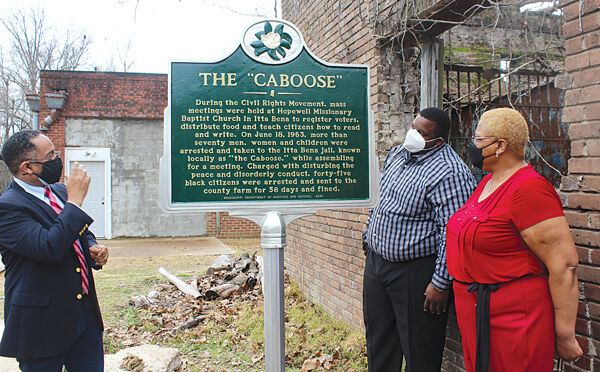 From left, Dr. Rolando Herts of the Mississippi Delta National Heritage Area, Itta Bena Alderman Reginald Freeman and Shannon Bowden reveal a historical marker placed by Itta Bena’s old downtown jail, which once held civil rights activists.
At the old downtown jail, known as the caboose, civil rights activists were incarcerated and jam-packed together.
Rick McCaleb, a former Itta Bena resident and the owner of the property, said he was told by numerous Itta Bena residents that a fire truck was used to spray water at those incarcerated.
In 1966, James Meredith, the first Black student to be admitted to the University of Mississippi, launched the March Against Fear to protest racism in the Delta and encourage Black people to register to vote.
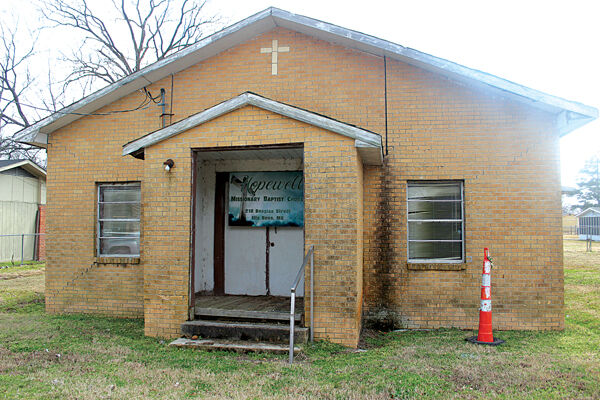 Hopewell Missionary Baptist Church, the site where civil rights activists registered people to vote in Itta Bena years ago, still stands.
The march, which began in Memphis and concluded in Jackson, passed through Itta Bena. It was at the turnoff on Mississippi 7 South where marchers went south to Belzoni.
The third historical marker, which will be a Mississippi Freedom Trail Marker, has yet to be erected, Bowden said, but it will be located at Hopewell Missionary Baptist Church, which was used as a voter registration site.
•Contact Gerard Edic at 581-7239 or gedic@gwcommonwealth.com.


