Wait and see.
That’s Lark Brown’s advice as Greenwood-area gardeners begin to survey the damage caused by last week’s winter storm.
“It got really cold, but I think most everything is going to come back,” said Brown, a master gardener and landscape architect. “It’s just sort of hit or miss. You just don’t know until spring.”
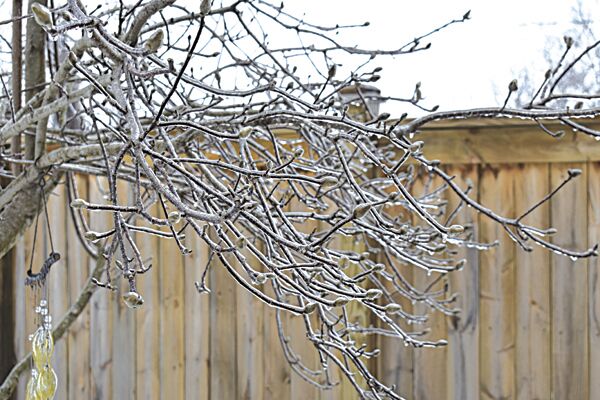 The limbs and new buds on this tulip tree are covered in ice.
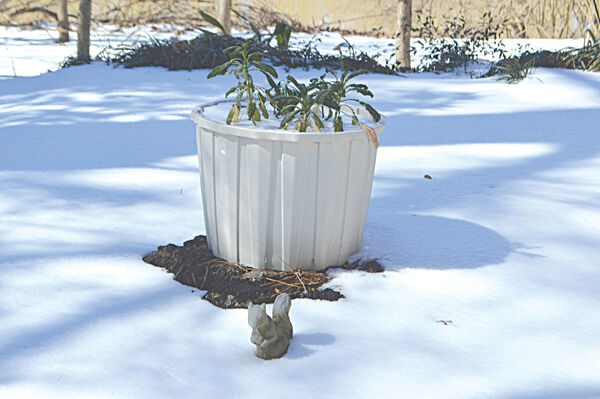 Snow and sleet are piled on top of this pot containing kale damaged by the cold.
The winter season of 2020-21 was shaping up to be a pleasant one. It had included mostly mild temperatures and one early-morning snow day with precipitation that melted away by noon.
“We had the most wonderful winter,” said Brown. “It was so mild, and everybody was enjoying it, and I thought we are really going to have an early spring.”
Then, Punxsutawney Phil, the weather-predicting groundhog from Punxsutawney, Pennsylvania, provided his forecast Feb. 2 for when spring would arrive. Six more weeks of winter weather, he predicted, and two weeks later his prediction felt true in the Greenwood area.
Temperatures dipped down to the teens last week. Snow, ice and sleet covered the roads, making driving hazardous. The winter storm lasted for almost a week. The icy precipitation covered not only roads but also everything green — the ground, plants, shrubs and trees. After the area thawed out over the weekend, many gardeners may now be feeling worried about what to do in the aftermath.
Before doing any heavy pruning or pulling up plants, Brown suggests to give it some time and wait until warmer weather arrives.
If there’s no new growth and the plants are not thriving by spring, “just go out with a pair of pruners when it’s not going to get any better and prune stuff back a little bit, if it needs to be,” she said.
Brown had some casualties in her own yard.
“I have broccoli — I even had it all covered — but it all froze because it got down so low,” she said.
Her other vegetables in her winter garden are also kaput.
She said it was caused by not only low temperatures but also the span of time that the winter storm lasted.
“My little heater in my greenhouse failed me for a little while, and I lost a couple of plants that were on one side of the greenhouse; they were so tender,” she added. “But some of the other stuff is just fine.”
Her daylilies also took a hit, but Brown is not worried.
“My daylilies look terrible, but they just had a lot of foliage, and all of that foliage would have died anyway,” she said. “Anything that has soft cells like a daylily, the cells froze, and when things freeze, water expands, and so it would break the cell.”
They’ll revive, however, “because they come back from the root.”
Her daffodils are “all green.”
“They were green the whole time,” she said. “They’re in the ground and are fine. A lot of stuff looks terrible. You just pull away the ugly stuff and wait. I think that’s the key.”
Many shrubs are now showing signs of winter burn. The symptoms — foliage that begins to brown at the tips of branches with browning progressing inward toward the center of the plant — are often noticeable after snow melts and the temperature begins to rise.
For boxwoods, “the tips are not as hardy as the older plant,” said Brown. The newer growth is tender, so the tips of some boxwoods are now showing signs of winter burn.
“You just have to prune it back a little bit,” Brown said.
She also noticed damage to some of the live oak trees at Fort Pemberton.
“They don’t really like to go into a deep freeze like that, but they will come back, and it takes them a long time to come back,” she said.
She said the trees will survive, although they may have a sickly appearance for about a year.
Most trees, such as magnolia trees, however, received little to no damage during the freeze, “because there wasn’t too much ice,” said Brown.
“There wasn’t a lot of weight on any of the trees,” she continued. “We were really lucky because the last time we had an ice storm it was terrible what it did to the trees, but the trees all look great.”
Some bushes and trees that had blooms will likely not bloom again until next year.
But for plants, gardeners in the area mostly grow hardy Zone 7 plants, rather than tender plants, which would not have survived the cold.
“I think most of the things we grow are pretty hardy stuff,” Brown said.
There was one positive outcome from the snow, sleet and ice, especially for those getting ready to plant.
“The soil is going to be incredibly soft,” Brown said. “It was freezing and thawing and freezing and thawing, and all that moisture just kind of gradually soaked in. The soil is going to be happy.”
And now’s the time to begin planning a garden, since many seeds call for being planted three weeks before the spring’s last frost. The Farmer’s Almanac says that the date of the last frost in the Greenwood area is April 2.
While it may take several more days of warmer weather before the full damage to yards and gardens from last week’s weather is revealed, Brown suggests to be patient.
“After by April, if stuff hasn’t come back, then it may not come back,” she said. “I wouldn’t cut anything back until the last minute.”
•Contact Ruthie Robison at 581-7235 or rrobison@gwcommonwealth.com.


