A little more than a year ago, when Amber Brock first heard that she had breast cancer, she was in disbelief of the diagnosis.
She had no symptoms and no family history of breast cancer, and she was young and under the age when most women are recommended to begin yearly mammograms.
“I felt like breast cancer, to me, meant death; It meant death then,” said Brock, who has worked as an EKG technician at Greenwood Leflore Hospital for 15 years. “I was in denial.”
But when she heard the words again, “Yes, Amber, it’s breast cancer,” Brock said, “I immediately started crying and praying because I’m like, ‘God, no, not me.’ But God has been with me every step of the way.”
• • •
Brock, 37, said it seemed as though the lump in her right breast appeared overnight. When she first noticed it, she said “it felt like a brick” under her skin.
After she told her husband, Kalmus, about the lump, he suggested that she get it checked. However, Brock, a busy mother of two, said she is the type of person who “takes care of everything” and “can’t get sick.”
Her brother had just died in April, and she had helped her mother with the funeral arrangements and felt she didn’t have much time to worry about herself. But her husband, who had had a cancer scare a few months earlier, insisted she immediately get a mammogram.
Brock said her husband was “being a typical man. I was like, ‘You don’t know what you’re talking about.’ So I got a mammogram just so he would shut up,” she said with a laugh.
On June 26, 2019, Brock had her first mammogram.
“I wasn’t nervous at all,” she said. “I was 35, so I went in there like it didn’t matter. ‘No, I’m fine.’”
She was apprehensive because she had always heard the screening can be painful. But to her surprise, “it did not hurt,” she said.
Brock felt she was getting the exam more to put her husband’s mind at ease rather than on the chance that she might have cancer. Also, the disease doesn’t run in her family.
“My mother has never had a mammogram, and she is 73 years old,” said Brock.
After the mammogram, Brock was told that some abnormal cells were spotted, and she needed to get a breast biopsy.
“I had no symptoms,” she said. “The only thing I felt was the lump, and I’m thinking, ‘This is just a cyst. This is nothing. I don’t have it.’”
Her breast biopsy was held on July 11, 2019. Once she received the results, she still couldn’t believe that she had breast cancer.
“I’m still in denial, but I’m taking it serious,” she recalled. “I called my husband, and I’m shaking because I have kids. I have a 17-year-old daughter and a 6-year-old son. My kids need me. I have a whole family, and plus with my mama, I had to be strong for her because one of my brothers just died.”
Brock and her husband decided to get a second opinion, in hopes that she would receive a different diagnosis.
“I wasn’t doubting this hospital, but in my mind I needed somebody else to tell me that it was wrong,” she said. “I wanted to hear that.”
Brock and her family traveled to Jackson to see a different oncologist a couple of weeks after her breast biopsy.
She felt calm on the ride there. The only people in her family who knew about the cancer were in the vehicle — her husband, their daughter, Kambria, and their son, Kalmus Jr., who really only understood that his mom was going to see a doctor. Brock had not yet told her mother, Margaret Sanders, that she might have breast cancer.
In Jackson, the second doctor confirmed the first diagnosis, and a nurse brought Brock a “pink” bag, which is given to those with breast cancer. That’s when the feelings Brock had been trying to avoid finally overwhelmed her.
“I cried,” she said. “I’m crying, like I cannot tell my mama. ... Everybody I’ve known with breast cancer, it’s hard on them, and now I have breast cancer.”
While the doctor was talking about treatment options, “I didn’t hear anything; I just heard breast cancer — death,” Brock said.
She said at first she wanted a mastectomy. Because of her young age, however, the oncologist recommended chemotherapy.
• • •
Brock had a strong support system. Her husband was encouraging, telling her, “I know it’s hard, but you’re stronger than this. You’re the strongest person I’ve ever seen,” she recalled.
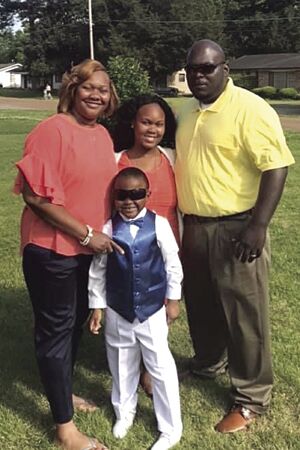 Members of the Brock family are Amber, Kalmus Jr., Kambria and Kalmus Sr. Amber’s husband, children and her mother, Margaret Sanders, were her biggest supporters as she faced a breast cancer diagnosis last year.
Her daughter was calm when Brock told her that a second doctor had confirmed the diagnosis.
“She said, ‘Mama, we’re going to do whatever we have to do to keep you here,’” Brock said. “That broke me down, because if my baby is talking like this, I know I got this.”
Telling her mother about the cancer diagnosis wasn’t as hard as Brock thought it would be.
Sanders called her during the ride home from Jackson, and, with some persuading by her husband and daughter, Brock told Sanders.
She said her mother replied, “God showed me something was wrong. God showed me that you were going to Jackson, and he told me to tell you you’re going to be all right.”
“She never cried on that phone,” Brock recalled.
After that conversation, Brock thought, “OK, God, I think I can do this.”
• • •
Brock had many worries. She worried how her diagnosis would affect her mother, her husband and her children. She worried about having to have surgery — her first surgery — to get a chemo port implanted.
And then, Brock also worried about losing her hair once she started the treatments, because “I’m the girl who gets my hair done every two weeks.”
With tears in her eyes, Brock expressed this concern to her mother. Sanders replied, “Why are you crying about hair? Hair does not make you.”
Then Sanders reminded her daughter, “Amber, you wear wigs anyway.”
With a laugh, Brock said her mother’s words made her realize she could overcome her fears and worries and get through her battle with breast cancer.
Later, at home, Brock cried and then prayed.
“I told God, ‘I don’t want to cry anymore,’” she said. “Sometimes worry will make it worse. So I knew if I had faith, I cannot worry like this. I knew God was telling me then, ‘I got you.’”
• • •
Brock’s breast cancer was caught early. She had stage 1 that was at the point where it was turning into stage 2.
In early August, her chemo port was implanted. The next day, Brock took her son to his first day of kindergarten. “I was not going to miss a day of his school,” she said.
A couple of days later, Brock began her chemotherapy treatments. She had to begin with four aggressive treatments, and the first one took all day.
Brock said she didn’t feel many of the side effects that the treatments often cause.
“I was just blessed,” she said. “I did not throw up. Nothing. I went through 16 rounds of chemo treatments with no aches and pains.”
Even though her treatments were on Thursdays, she still went to every high school football game on Friday night to watch her daughter perform in the band. She also continued to work every day.
“I felt like if God is going to wake me up in the morning, I’ve got to move,” she said. “I can’t stop. Why stop?”
Brock finished her chemo treatments on Jan. 16. “That was the best day ever, but it was the best day for me,” she said.
She couldn’t help feeling a little sad that day because she had made friends with many of the other people also receiving treatments. “I had got close to the people that I was doing chemo with, even the nurses,” she said.
In February, Brock had a lumpectomy, a surgery to remove the lump from her breast. The operation went well, and the doctor did a lymph node test, which came back cancer free.
“That was amazing to hear,” she said.
Brock also had to complete 33 days of radiation therapy. She started Aug. 19 and finished Monday.
“I’m grateful,” she said. “I had to go through something. It’s like a testimony, and I’m still not questioning God about why this had to happen to me, but He wanted to show me something.
“I thank God for allowing me to still be here, because a lot of patients who I come into contact with now they feel like it’s the end, but it’s not the end. You’ve just got to have faith.”
Now Brock is an advocate for mammograms and early screening. “Even if you feel something — it could be anything like a little spot — just let a doctor tell you it’s a spot,” she said. “Don’t doctor on yourself.”
• Contact Ruthie Robison at 581-7235 or rrobison@gwcommonwealth.com.


