The joint committee tasked with developing a plan to redraw Mississippi’s four congressional districts and 174 legislative seats held its fourth public hearing Wednesday evening at Mississippi Valley State University.
The hearing, ultimately one of nine that will be held across the state, offered members of the public an opportunity to voice their views about redistricting.
Among the concerns addressed Wednesday was the desire to keep communities of interest intact when redrawing the congressional districts, specifically the Second Congressional District.
Unlike the state’s three other congressional districts, which are predominantly white in population and all represented by Republicans, the Second Congressional District leans Democrat, and the majority of its voters are Black. The district, which includes Leflore County, is represented by U.S. Rep. Bennie Thompson, a Democrat, who attended the hearing.
“Please don’t split communities of interest up. To the extent that you can, try not to split (voting) precincts,” Thompson told the committee. “We are one of the few states that lost population, so you’re going to have to make adjustments. When you look at those adjustments … can we make adjustments on the congressional side with as minimal amount of statistical upheaval as we possibly can?”
Because the Delta has lost population, the Second Congressional District will have to be expanded so that the four districts are roughly equal in population.
Melvin and Marilyn Young, a husband and wife from Tunica who prepared a congressional redistricting map for the committee, suggested that District 2 not be extended northward toward DeSoto County but instead southward within the Natchez area.
“We ask that a district must be composed of a continuous territory,” Marilyn Young said. “Districts should be compact; they shouldn’t have all type of irregular shapes. The redistricting plan should avoid purely racial gerrymandering. The redistricting plan should avoid political gerrymandering.
“We should also ask that the redistricting plan be redrawn so that it minimizes the cost of election administration and voter confusion,” she added.
“Gerrymandering” refers to the redrawing of boundaries to give an advantage to a certain group.
George Whitten, a Greenwood attorney who has had extensive experience with the voting process in Leflore County as a paid poll worker and a volunteer poll watcher, also spoke about reducing confusion on election day for the voters and the county election commission.
“It’s helpful to have as few subdistricts and split precincts as possible,” Whitten said.
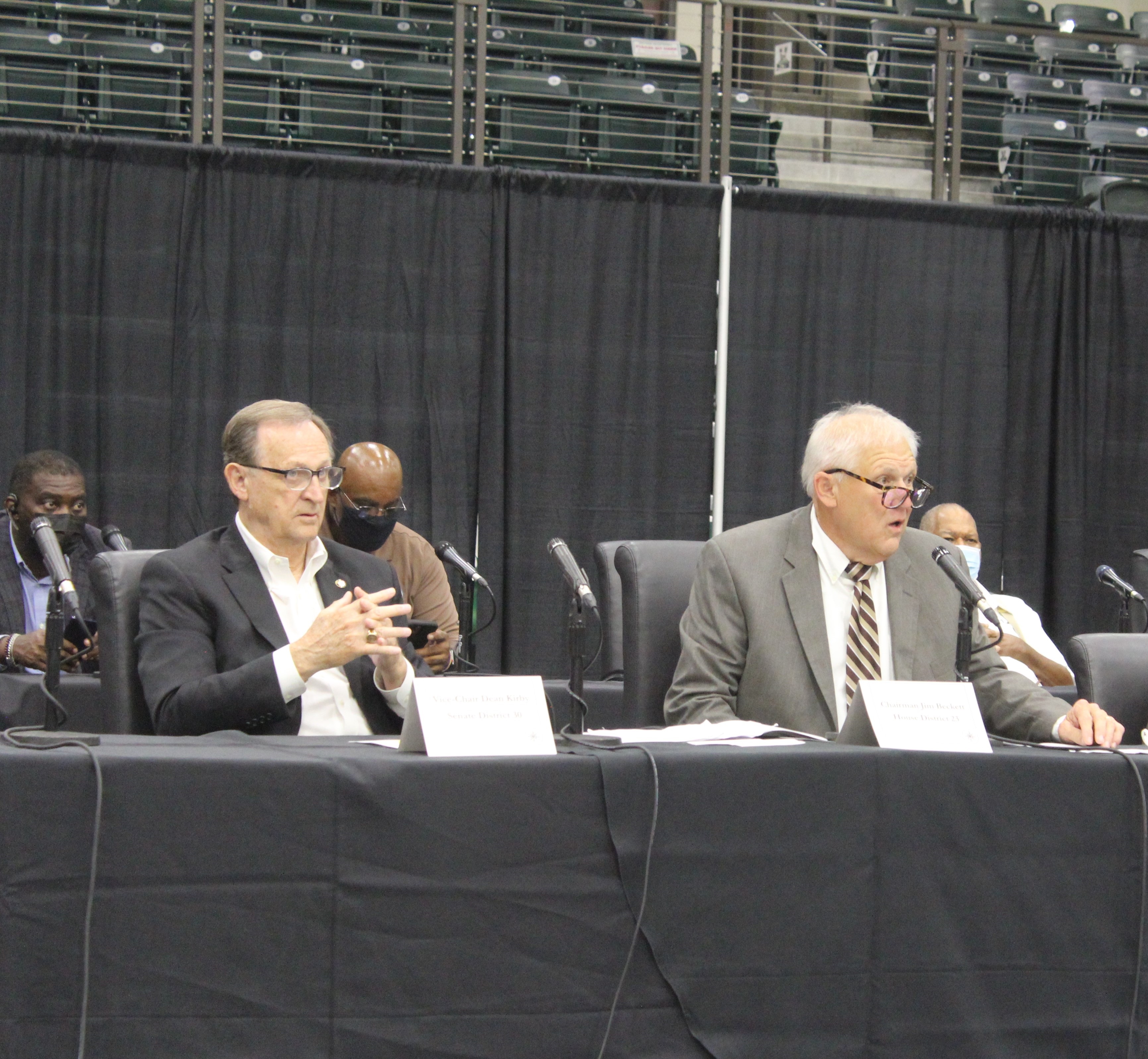 State Sen. Dean Kirby, R-Pearl, left, the vice chairman of Mississippi’s redistricting committee, and Rep. Jim Beckett, R-Bruce, the chairman, listen to members of the public address concerns about congressional and legislative redistricting during a public hearing Wednesday afternoon at Mississippi Valley State University. (By Gerard Edic)
Rep. Jim Beckett, R-Bruce, the chairman of the joint committee, said, “We’re going to draw as few split precincts as possible — legally possible.” He noted, however, that the redrawing of districts inevitably will require counties to adjust their voting precincts.
Redistricting, or the redrawing of district boundary lines at the congressional and state legislative level, occurs every 10 years following the results of the latest U.S. Census.
Preliminary results from the 2020 Census, released earlier this year, indicated that Mississippi’s population is 2.96 million people, a decrease of 6,018 residents since 2010. Despite this loss, the state will not lose a congressional seat.
On Thursday, the Census Bureau released further details from the census, which includes data on voting-age, racial and ethnic makeup of communities across the country. This is the type of data state legislatures take into account when redrawing districts.
The Mississippi Legislature, which is dominated by the Republican Party within both chambers, is in charge of redrawing the districts. It must approve the redistricting prior to next year’s mid-term elections.
One of the concerns of redistricting is that the Republican Party will redraw boundaries to capture areas that are favorable to Republicans.
“We understand that you have the final authority to vote on those plans, but we are very concerned about trying to make sure that you don’t rack up on a lot of unnecessary seats just because you have the numbers to do so,” Marilyn Young said. “We want those numbers to be fair, and we want to stay an integral part of the process.”
Beckett said he would like to have the Legislature pass the new congressional redistricting early next year during the legislative session, which begins in January, according to Mississippi Today.
The legislature will have more time to redraw the state’s 174 legislative districts, which include 122 House seats and 52 Senate seats, since the next state elections are not until 2023.
By Oct. 10, the state’s redistricting committee will open its public access office, where individuals and groups may make appointments to use legislative redistricting resources to develop plans to submit to the committee.
The redistricting committee may also be contacted by mail at c/o Ted Booth, P.O. Box 1204, Jackson, MS 39215-1204 or by email at ted.booth@peer.ms.gov.
- Contact Gerard Edic at 581-7239 or gedic@gwcommonwealth.com.


