One Saturday morning last spring, a group of nine sixth graders at Leflore Legacy Academy were seated at their tables in the cafeteria when they heard a “pop, pop!” that sounded like gunshots.
They immediately scrambled and hit the floor. Some hid underneath their tables. After several seconds, they rose up. Then, another “pop, pop!” They scrambled and hit the floor again.
No actual gunshots had been fired inside the charter school. Instead, the “pop, pop” came from Shun Pearson, a longtime Greenwood community activist whose decades-long mission has been to steer at-risk youth from the perils of gun violence.
He was leading an exercise, similar to that of a fire or tornado drill, in which the students were trained to duck to evade gunfire. That way, in case the students happened to be caught up in a real-life shooting, they’d know what to do.
Gunfire has become standard background noise in various neighborhoods and is widespread throughout Leflore County.
The names and faces of the victims can be seen on hoodies worn by students at school, on billboards across town and at the National Gun Violence Memorial, a nonprofit website that seeks to humanize gun violence victims beyond mere numbers.
“That’s the thing hurting us the most: We’ve become numb to the situation,” said Kenderick Cox, a former Greenwood High School teacher who’s lost several students to gun violence.
“You can leave your house and say you’re going to the grocery store, and all of a sudden you end up in gunfire,” said Janice Johnson, who lost her youngest child, Kenton “Buddy” Johnson, to gun violence in January 2020. “Even sitting at home you’re not safe. Bullets can fly through your window, through your door.”
From her Greenwood residence, she said she regularly hears gunshots. “It’s not safe for your kids to be out. You can become a murder victim by just sitting on your porch, lying in your bed.”
Addressing gun violence is complex since the problem is rooted in quality-of-life issues and some solutions that anti-violence advocates say will work, such as universal background checks and firearms regulation, considered unlikely in Mississippi, are made through reforming laws.
The exercise Pearson was leading last spring was part of a six-month youth summit he held at Leflore Legacy. Various topics, from managing behavior on social media to dealing with peer pressure, were addressed, all in an effort to build up the students’ emotional and social awareness so they could live a life away from violence.
For years, local residents such as Pearson have been developing and pitching to the city of Greenwood and Leflore County these types of initiatives: long-term preventive solutions they say will curb gun violence. The hope is that they’ll get adopted, but efforts mostly have been unsuccessful.
In recent years, the city and county have occasionally issued emergency declarations to allow for assistance from outside law enforcement agencies after a wave of violence.
Attempts have been made to bolster their respective law enforcement agencies. Both local governments also allocate funding to several community organizations that provide social services, such as recreational programs and mentorship and tutoring for youth.
Absent in the county, however, is any formalized anti-violence initiative backed by the local governments that provides targeted interventions to those most at risk of committing or dying from gun violence.
The result is a scattershot approach to addressing gun violence in which residents, alarmed by the ongoing rash of shootings, shoulder the burden themselves by forming their own community organizations by the dozen without any institutional support. In some cases, these organizations, without any administrative infrastructure, evaporate.
A myriad of issues in the community — poverty, unaddressed trauma and conflict, lack of meaningful opportunities, including youth recreation and well-paying jobs, and a continued access to firearms — means that the conditions that lead to gun violence are likely to continue to fester.
- - -
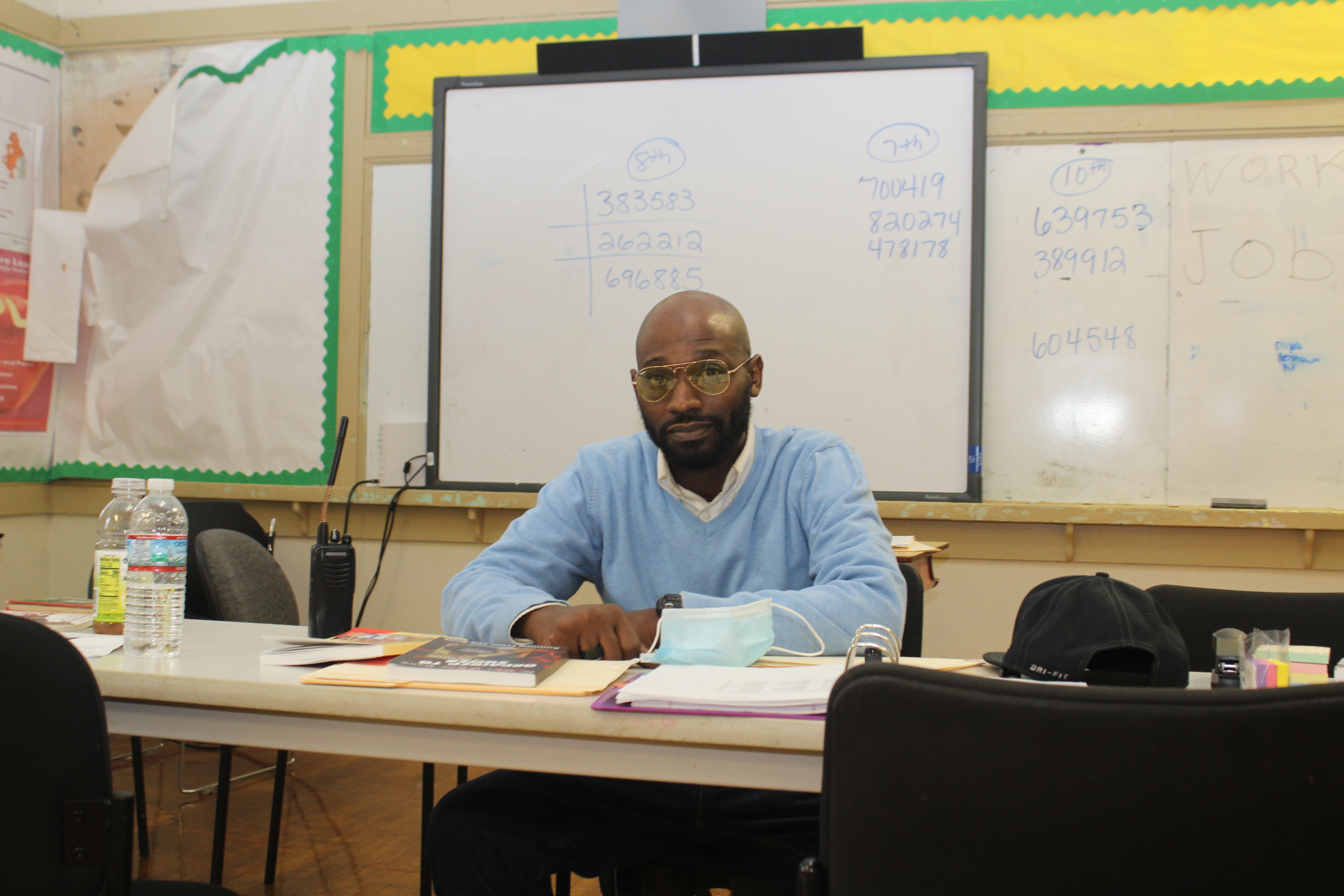 After losing his son to gun violence last summer, Tavarris Cross has found solace in his job as an inclusion support teacher at Leflore County High School. (By Gerard Edic)
Greenwood resident Tavarris Cross, an inclusion support teacher at Leflore County High School, had an idea to get the different community organizations in the county together to address gun violence collaboratively.
Following a particularly violent week in May 2021 in which six people were killed, five by gunfire, Cross was moved to action.
He drafted a proposal for a coalition, the Greenwood-Leflore County Coalition against Gun Violence, and sent copies to the heads of various local institutions, including Greenwood Mayor Carolyn McAdams, Reginald Moore, then the president of the Leflore County Board of Supervisors, Greenwood Police Chief Terrence Craft and Sheriff Ricky Banks, among others. He asked them to act as figureheads for his initiative, promote nonviolence and educate the community about the dangers of gun violence through a mass marketing campaign.
His idea was that the coalition would serve as an umbrella organization for other community groups.
“I have stressed to each of my peers time and time again that you can maintain your independent organization’s goals but find some way to find common goals and ways to work collaboratively to address issues in the community instead of just catering to your own organization,” he said.
Though logistics and a budget still needed to be ironed out, the initiatives detailed in Cross’ proposal included a community liaison who would serve as a bridge between local governments and high-crime communities.
The liaison, a resident of the community, would provide counseling to gunshot victims and team with local authorities to develop other targeted violence intervention programs. Additionally, the liaison would work with community organizations to put out information about the effects of gun violence and give residents a platform to testify how gun violence has affected their lives. Cross’ idea was that if the community were informed of the scope of gun violence, residents might react differently, he said.
“I didn’t want the city to give us any money to play football, baseball, anything with a ball. I was looking for our groups to work collectively together and the city and county to provide in-kind donations for our workshops, seminars and other community programs geared towards stopping gun violence,” Cross said. “That was my intention with that — to provide some serious gun violence intervention programs for Greenwood and Leflore County at large.”
Cross spearheaded two meetings — one at the Greenwood Community and Recreation Center and another at New Zion Missionary Baptist Church. Present at each meeting were the heads of different community organizations who listened to Cross’ appeal to have them work together.
The reaction, Cross recalled, was generally receptive with some people supporting his idea. Still, he said others told him to form his own group.
Before Cross got a chance to approach both the city and county to discuss his coalition, including the liaison aspect, his 18-year-old son, Artavius Gillis, was shot and killed in mid-June.
Gillis, a graduate of Amanda Elzy High School who played football all four years, was considering going into a welding program at Mississippi Delta Community College. He had also applied to the University of Southern Mississippi and was awaiting an application decision, Cross said.
“After my son was killed, the energy was taken out. I lost my drive. I really did,” Cross said. “Since that time, I’ve been mourning the death of my son.”
- - -
Gun violence, an ongoing, pervasive issue that disproportionately affects the Black community, seems to have only grown more senseless over recent years. All of the homicide victims in Greenwood and Leflore County from 2019 to 2021 have been Black. Most of them were men.
Furthermore, the age of the victims has gotten younger, from a 12-year-old Greenwood Middle School student who was shot and killed in March 2019 to a 21-month-old toddler who died last May after the vehicle in which she was traveling with her family was hit by gunfire.
Innocent bystanders have also been caught in crossfire. A mass shooting in Greenwood in October 2020 led to the deaths of a brother and sister from Chicago and the injury of at least eight other people after an AR-15 wielding assailant fired indiscriminately at a post-funeral gathering. A 19-year-old woman was fatally shot outside a graduation party in Greenwood in May of last year. In both cases, authorities said the victims were not the intended targets.
Leflore County experienced a surge of 23 reported homicides in 2020 — 22 involving guns and double that of 2019’s homicide count of 11 — leading to the highest count in at least a decade, according to a tally by the Commonwealth.
In 2021, there were at least 18 reported homicides, 16 of which involved guns, accounting for the second highest count in a decade.
Then there are the countless incidents of non-fatal shootings that have left people injured and homes and cars shot up. Harder to quantify is the fear that has gripped the community.
- - -
Those responsible for gun violence in the community are believed to be a small subsection of people, typically young men belonging to informal neighborhood groups that in some cases get into conflicts with each other, according to Ryan Parsons, a doctoral candidate in sociology and social policy at Princeton University.
“There’s a lot of pressure for young men living on the street to either get involved with the group or be victimized by it,” he said.
A Hattiesburg native who received his bachelor’s degree at the University of Mississippi, Parsons lived in Greenwood from June 2018 to August 2021 and still makes occasional visits. Over the course of his stay in the Delta, he interviewed about 40 low-income families in Leflore County and about 100 in Sunflower County. One of the frequent topics that came up during his interviews with Leflore County residents was gun violence.
“In general, there’s a small minority of people who are involved directly in gun violence in terms of pulling the trigger or being shot at — the literal people who are directly involved. There’s an exponentially larger number of people who are impacted on the side,” Parsons said. “So, you have somebody who drives by and shoots up the house. The target may have been this one guy, but his family is there, too. You have these random shootings where people just get hit by a stray bullet.”
Guns, including assault-style rifles, are plentiful throughout the streets, residents say, and have taken on a symbolic meaning of empowerment. It’s become common for residents to show off their firearms on social media.
“In the African American community there’s been so much that’s stripped away from that community in the form of power and ownership,” said Charles Brown, an assistant principal at Greenwood High and a candidate for a seat on Greenwood’s City Council last summer. “The gun shows power. It gives them a sense of power. ‘Look at me, this is what I got. This is what I can do.’ Guns make them feel powerful in their inadequacies.”
- - -
Community organizations do play an important role in curbing violent crimes, according to research.
A widely cited 2017 academic paper by Patrick Sharkey, a criminologist and sociologist at Princeton University, found that every additional 10 community organizations “focusing on crime and community life” in cities of 100,000 people “leads to a 9% reduction in the murder rate, a 6% reduction in the violent crime rate, and a 4% reduction in the property crime rate.”
Determining that same effect on smaller communities, such as Leflore County, with a population of just over 28,300 residents — about 14,500 of whom reside in Greenwood according to the 2020 U.S. Census — is harder to calculate, Parsons said.
Locally, there are several community organizations that seek to fill various structural gaps that exist in the community. Most initiatives, as Parsons observed, focus on providing interventions for young males through sports and other recreational activities as well as counseling and mentorship.
“I’m not really familiar with anything that is trying to de-escalate or intervene,” Parsons said. “There’s an exclusive focus on children, which is important, but there are also people who are older than that who could be helped.”
An abundance of these community organizations clustered in one area can also water down their services.
“There’s an economy of scale issue where if you have 10 different people trying to fund themselves it’s less efficient than one organization that can share resources,” said Parsons.
“That’s a symptom; that isn’t the problem,” he emphasized. “The problem is that there’s no formal (anti-violence) organization where (residents) can put their energy. … People feel frustrated, and they have to do everything from scratch.”
An anti-violence organization that has the same level of professionalization and institutional support as United Way or the Boys & Girls Club “would be a welcome and effective addition to the city,” Parsons said.
- - -
Aside from Cross’ efforts, there have been other attempts from the community to form an organization or coalition to address gun violence, but they have fallen by the wayside.
Many local community organizations are grassroots in nature, in many cases lacking the needed money, administrative infrastructure as well as a physical location. Because of this, some of these movements die out months after they’re formed.
“It’s a moment, not a movement,” Cox said of the process. “It’s becoming more and more we’re just talking.”
Cox, who ran for mayor of Greenwood last summer and made the issue of crime one of his key platforms, said the local governments need to address gun violence more proactively rather than just making public platitudes.
Past gun violence emergency declarations issued by the Leflore County Board of Supervisors and the Greenwood City Council, each in response to fatal shootings, have been reactive measures rather than proactive, Cox said.
He added that it’s the local governments that have the specific power to enact changes, unlike many community organizations. These include placing pressure on housing complexes where gun violence is frequent to have them beef up their security, allocating more funding to community organizations that serve at-risk youth, such as the Greenwood Community and Recreation Center, and providing youth with employment opportunities.
“Our government is disassociated from the community. They’re accustomed to how things have always been, and it’s not conducive to our community,” he said.
- - -
Stockpiled in the bank accounts for the city of Greenwood and Leflore County are millions of dollars in pandemic relief funds from the federal government’s American Rescue Plan that can now be used for various public safety initiatives, including funding for community violence intervention programs, or CVIs. President Joe Biden’s administration has touted CVIs as one of several preventive strategies that local governments can adopt to curb gun violence.
CVI programs seek to break the cycle of violence by providing needed social services to those most at risk of committing gun violence or becoming a victim of it. These types of programs include conducting a series of in-person meetings among credible members of the community and those at risk of committing or becoming victims of gun violence; the use of “violence interrupters” who defuse altercations before they potentially become deadly; and connecting hospitalized gunshot victims with social caseworkers to assess what their needs are to ensure they don’t wind up back in the hospital. Research has shown that these programs do have a proven effect.
No such measures, at least on the professional level, exist in Leflore County. Robert Collins, president of the Board of Supervisors, and Mayor McAdams said in recent interviews that they were not familiar with the concept of CVI programs.
Amid a nationwide spike in homicides, cities and counties across the country have announced plans to allocate portions of their federal pandemic relief funds toward CVI programs, including Multnomah County, Oregon, which includes the city of Portland, along with Indianapolis, Indiana, Akron, Ohio and Louisville, Kentucky.
Greenwood has already received its first half of the federal pandemic relief funds — $1.6 million of a total $3.2 million — while Leflore County received $2.7 million of a total $5.4 million. Each entity will get the second half of the grant funding later this year.
Neither Greenwood nor Leflore County has spent its federal funds yet. The county supervisors haven’t made any formal plans to allocate their funds, and McAdams said she’d like to use the city’s money to reline or replace Greenwood’s sewer pipes — more than half of which are 75 years or older, she said.
Collins acknowledged that past community efforts to deter violence, such as cookouts or recreational activities, eventually “fall by the wayside. Nobody sticks to it.”
He said the Greenwood Police Department and Leflore County Sheriff’s Department “don’t have the time and resources” to commit to the efforts undertaken by CVI programs but said that he would be willing to use some of the county’s relief funds toward formal anti-violence initiatives.
McAdams said ensuring the Police Department is fully staffed as well as installing cameras are examples of the city’s measures to stem gun violence. So far, the city has installed 30 surveillance cameras with plans to add 15 to 20 by the end of this year.
“Our goal is to put up as many cameras annually as we possibly can,” she said.
- - -
There is no magic spell to make gun violence go away, but the presence of professionalized preventive measures, such as a CVI program, could improve the problem from where it is, according to Parsons, the Princeton graduate student who studied poverty in the community. Until then, Leflore County residents, undeterred, will continue developing their own initiatives.
“We focus on death. We focus on afterward. Prevention is not getting a lot of traction,” Pearson lamented. “I think we need to invest in life.”
Ever dedicated to his cause, Pearson said he will have another partnered program with Leflore Legacy later this year.
Cross, though still grieving, has found solace through his work at Leflore County High School, where he helps students in the seventh and eighth grades pull their grades up.
“Since I lost my son to gun violence, I felt that working in the school system would give me an opportunity to speak with kids at an early age to try to deter them from that type of behavior and that type of involvement with gangs,” he said. “I tell them every day I’m here to help them.”
- Contact Gerard Edic at 581-7239 or gedic@gwcommonwealth.com.


