Henry da Massa of Manchester, England, carefully extracts an old vinyl record from its sleeve and places it on the turntable. He has two record players set up on the tailgate of his Chevy pickup; in a moment, he will have discs spinning on both. A bluesy female voice issues from the speakers, conjuring images of Mississippi in general and — for da Massa — Greenwood in particular.
“There’s no digital version of this,” da Massa said. “I’m probably the only person who’s ever played it on the radio.”
A self-described blues tourist who has visited Greenwood off and on for several years, da Massa has made the trip from Manchester to Greenwood three times this year alone — in February, in July, and again in mid-September, resulting in his current stay. He records blues albums combined with live audio for broadcast on @vinylnightradio, a web-based radio station in England.
“I think this is my 12th overall visit,” he said Tuesday at his apartment on Pearl Street, which he has nicknamed Blues Alley. “The Rodeway Inn and the Waffle House can both vouch for that, as they have been central to my many trips to Greenwood.”
Da Massa formed the Esoteric Blues Society in England — described on its website as a “non-profit, loss-making, for-love-only venture” — to curate the music he loves and maintain his blues-related ventures in Manchester.
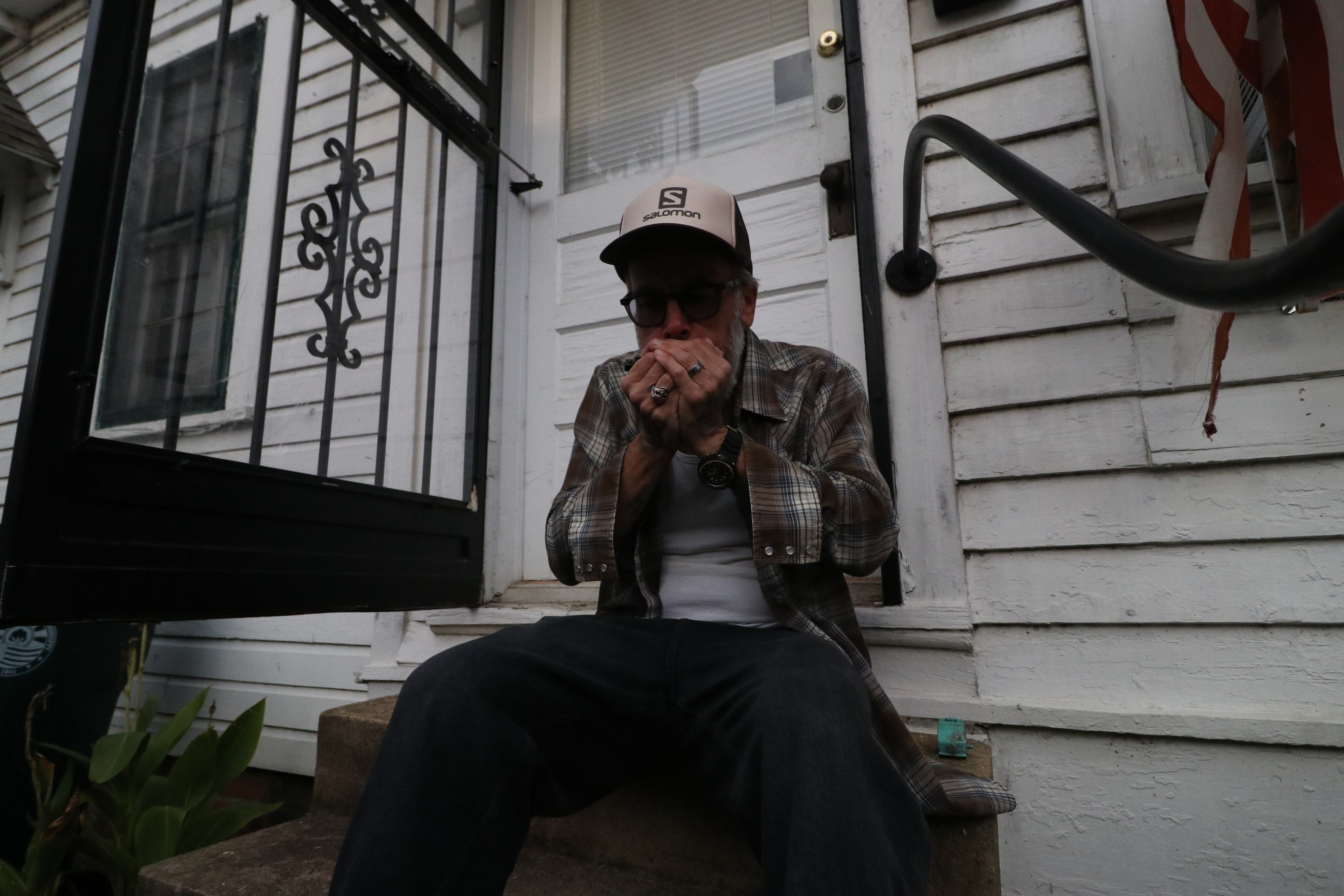 Henry da Massa plays the country blues harmonica. (By Dan Marsh)
Vinyl Night Radio plays records five nights a week, “encouraging people to sit back and reconnect with each other over an awesome soundtrack.” Da Massa records his radio shows in a variety of locations in and around Greenwood, ranging from his apartment to the Farmers Market to a former barbecue restaurant on Carrollton Avenue.
“To me, the blues is Greenwood,” he said. “I just try to create a space where music can happen.”
Da Massa said he sometimes enjoys sitting outside his apartment on “Blues Alley” and playing the blues on his harp or guitar. “I’m not a musician, and I don’t play guitar very well,” he said. “I picked up the harmonica in England because I thought, ‘How hard can it be?’ To get any good, you have to keep it in your shirt pocket.”
He enjoys the music scene in Greenwood, including this year’s Rhythm on the Rails series, but wants to see it expand.
“There needs to be more live music in Greenwood,” he said. “I don’t necessarily need to be making it or even a part of it, but sometimes I have to ask myself, ‘Where in the world am I?’”
He first came to the U.S. in 1991, and he and his daughter passed through Greenwood on their way to Clarksdale on a subsequent visit. He then returned to Greenwood years later and since then has come back every year except 2020, due to COVID.
“Those first trips really planted the seed that Greenwood was special,” he said.
His radio program consists of two or more turntables each spinning a vintage disc — music or spoken-word — while he records them for his weekly broadcast.
“I don’t play a record and then talk, play a record and then talk,” he laughed. “I like to create layers of sound because that is how we experience the real world. You never just hear one thing at a time.”
He likes to capture the feel of life in Greenwood, or wherever he happens to be, and combine that with a blues recording. The method creates unusual layers. “I don’t wear headphones; I don’t know what this sounds like,” he said. “All I do is adjust the volume, really.”
Real-world sounds are also captured — traffic, the nearby Amtrak train, and other voices. All these go into his recording for broadcast.
“Sometimes it’s just the sound of the Yazoo River,” he said. “It’s a very interesting sound for radio.”
“I’m not a blues historian,” he said. “I’m not a scholar or an expert. The blues is a very niche form of music where I’m from, but I relate to it because I come from a blue-collar, working-class background. Manchester is and was heavily industrialized. So was Greenwood, at one time. It was the Cotton Capital of the World. There’s a feeling here and in Manchester that, 50 years ago, things were much different.”
Da Massa feels such a passion for the music that in 2020 he designed the Lost Highway Juke Joint from a “rusty old shipping container” in which to house his valuable records and equipment and provide an authentic Mississippi blues experience in central Manchester.
“I’d been running my blues events in Manchester in clubs but had always felt constrained by them,” he said. “So I embarked on a project to put the blues in a more holistic concept.”
The version of this concept that he settled on was converting a shipping container he found in a construction yard into a realistic recreation of a Mississippi highway juke joint. “It involved working with steel and wood and creating a space to play records and have artists perform live music on the front stoop,” he said.
Da Massa completed the project in 23 days in the summer of 2020, though it took him a year to find someone who could help him build and site the container in central Manchester. He hosted 10 days of live acoustic country-blues played by special guest artists from all over the United Kingdom.
“No one in central Manchester had ever seen anything like it,” he said, noting that his concept is to have the juke joint “materialize” every year or so for 10 days in various locales. “It was very comfortable,” he said. “A really enjoyable experience. I remained as anonymous and invisible as possible. I simply try to provide a framework for the music.”
In the U.S., da Massa often conducts wide-ranging searches for old blues records, having gone as far as Cincinnatti, Ohio, from Greenwood.
“I’m acquiring vinyl all the time to keep the content fresh,” he said. A crate of records on his tailgate contains a few recent purchases from a local store. “I’ve never bought a CD,” he said. “I’ve never downloaded a song. I’m always lugging around records.”
One thing he hopes to put across to listeners in England is the historic experience of blues singers in Mississippi.
“We’re talking about civil rights,” he said. “You cannot separate the history of this place from the music.”
Much of what he records in Mississippi “sounds alien” to listeners in England, “much as my accent probably sounds in Greenwood.”
He doesn’t know how many more weeks he will remain in Greenwood on this visit. His daughter, Pearl, is a student at the University of London. “We’ve agreed that while she’s in university, I’ll probably spend as much time as I can in the States.”
Contact Dan Marsh at 662-581-7235 or dmarsh@gwcommonwealth.com.


