Wesley United Methodist Church’s brick, late Victorian Gothic-style building has been a beacon in the community for almost a century.
The church itself was organized more than 100 years ago — in 1870 by the Rev. John Wesley Dunn, after whom the church was named.
The beautifully crafted building it is housed in now, however, was built in 1921 and is listed on the National Register of Historic Places.
“It’s a historical church, and we want to keep it that way,” said Sidney Stevenson, a lifelong member of Wesley. “We would like to stick with that location, because our motto that we use is ‘the lighthouse of the community.’”
Due the normal wear and tear that naturally occurs within a nearly 100-year-old structure, however, the doors to the church had to be closed earlier this year.
Because several renovations were needed, the congregation could no longer meet at its beloved place of worship. The last time a service was held at the church was on Jan. 28. Since then, its members have been meeting at Decell United Methodist Church.
This was heartbreaking news, not only for Wesley’s many devoted members but also for the community surrounding its 800 Howard St. location.
“The neighborhood wants the church to stay,” said the Rev. Mary Willis, the church’s pastor. “When I began here, before I had met anybody, I wanted to know where the church was. I rode through the community, and they know who you are. People were asking, ‘When are they going to open back up?’ They’re looking for Wesley to open back up. The community needs Wesley.”
Willis became pastor of Wesley in June. When meeting with church members during her interview, Willis said she could feel their sadness. After answering some questions, Willis asked the members if there was anything they’d like to share with her.
That’s when lifelong Wesley member Alma Henderson said, “We want to go home.”
“My heart just dropped,” said Willis. “I looked at their faces, and I saw all these sad faces. They were really devastated. I could see their faces for a week or so, and I could hear her saying, ‘We want to go home.’”
Repairs to the church finally began in June.
“When we left the church in January, we had no idea when, how or what we were going to do,” said Jo Evelyn Stevenson, who is married to Sidney and has been a member of Wesley for 50 years. “It was home, and you’d just rather be at home.”
After almost nine months, the doors to Wesley United Methodist Church will reopen Sunday morning.
“I prayed every day that we could eventually get back to Wesley,” said Jo Evelyn Stevenson. “When we saw no way, the Lord brought us through it, and he got us back.”
{{tncms-inline content="<p><strong>What:</strong> Wesley United Methodist Church will reopen Sunday.</p> <p><strong>When:</strong> Sunday school will be at 9:30 a.m., and worship will be at 11 a.m.</p> <p><strong>Where:</strong> 800 Howard St.</p>" id="141e0763-db98-4a4f-a38e-59567b71358f" style-type="bio" title="Coming up" type="relcontent"}}
• • •
Wesley started out as a Methodist Episcopal church and later joined the United Methodist Church. It was established shortly after the Civil War.
Dunn, who was the presiding elder of the Greenwood Methodist Episcopal District from 1877 to 1879, organized the church out of a desire for the African-American community to have a greater voice in church affairs.
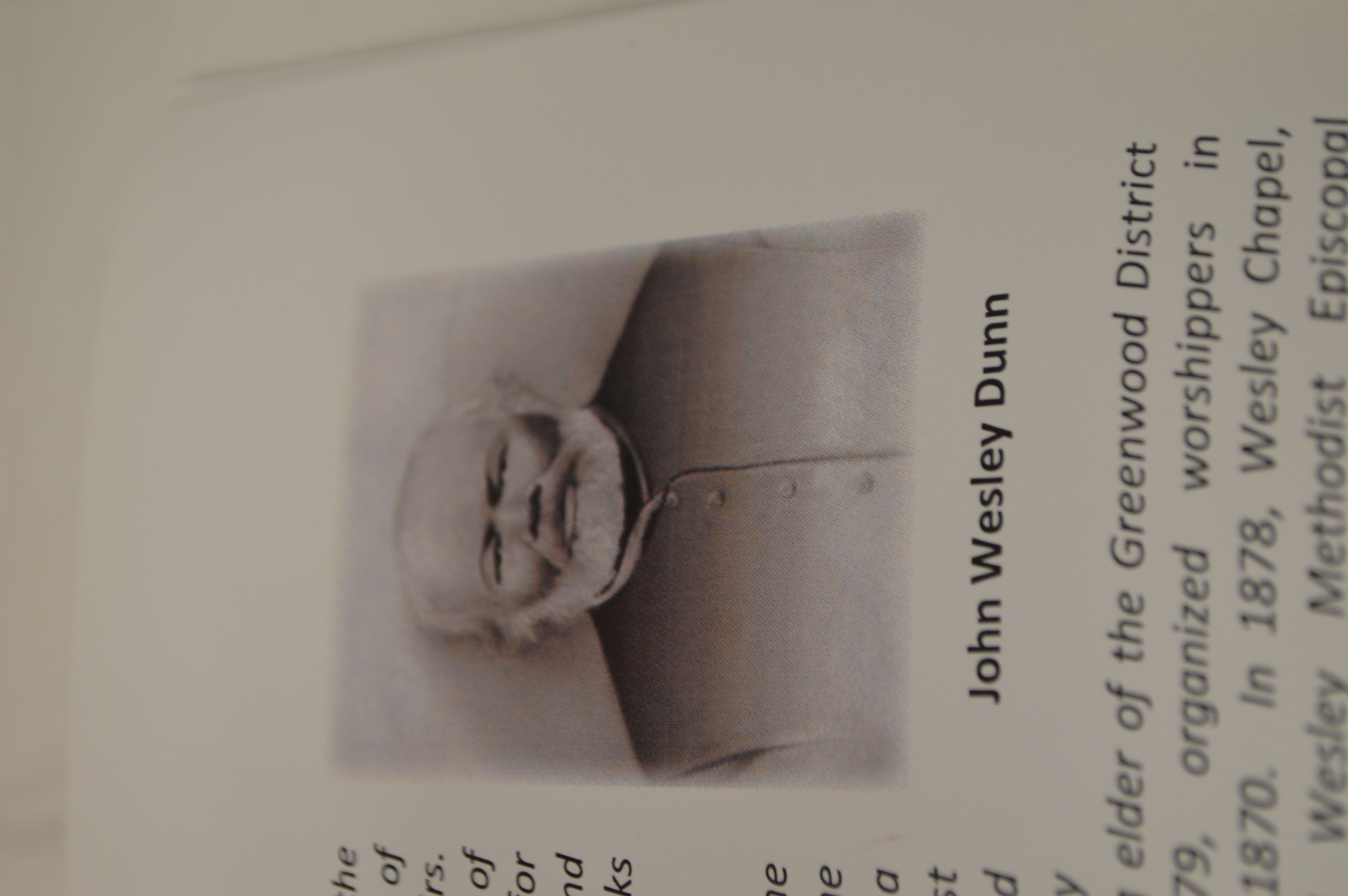 Dunn
Dunn
Henderson’s grandmother, Anna Hunter, was one of the first members of the church.
“My grandmother was in the house sitting on the couch when John Wesley Dunn started the church,” said Henderson, who is one of four generations of Wesley members in her family. “She was there when they first organized it.”
In 1878, the church — called Wesley Chapel at the time — was erected on Washington Street near the Elks Club, now known as the Historic Elks Building.
Records state that the church was located on Washington Street until about 1890, when the frame building was moved to a new location and remained there until it was destroyed by fire in 1920. Work on the current building began in 1921, following the approval of the building plans by the Bureau of Architecture of the M.E. Church in Philadelphia Pennsylvania.
Members of Wesley said the Rev. H.B. Hart, who was pastor of the church when it was being constructed on Howard Street, wanted an architectural design similar to a church he had seen in St. Louis.
It was reported that the cost of the new building was $50,000.
The plans, along with a sanctuary that seats 500, included four classrooms, a choir room, a small office and a companion gymnasium wing.
Wesley’s 16,500-square-foot design also included an auditorium and community hall, consisting of two stories and a basement.
The building was constructed of reinforced concrete, brick and stone. Frank R. McGeoy of Greenwood was the architect.
When construction began, Wesley had the largest African-American congregation in Greenwood. Church records state that when the construction finished, Wesley was one of the most complete churches and community buildings in the state.
Wesley Methodist Church was dedicated Monday, Jan. 16, 1922. Bishop R.E. Jones said during the ceremony, “The church is intended to be a community center, where the whole race of Greenwood may center its activities, and it is magnificently appointed for that purpose.”
Since then, those words have continued to remain true for Wesley.
Several years later, during The Great Depression, the church’s basement served as a shelter for the homeless.
Henderson said, “When people didn’t have anywhere to stay and they were hungry,” they would come to Wesley.
“It was sectioned off,” said Henderson. “My grandmother carried me down there when I was a child, and they had sectioned it off with sheets and people and families lived down there.’
During the Jim Crow era with “separate but equal” laws, the church became a community center for African-Americans who resided in Greenwood.
“All the big activities like graduation and things that were big and needed an auditorium, they came to Wesley, because it was large enough to hold everyone,” said Henderson.
The church became a substitute for the high school gym, said Adlena Crockett, who has been a member of Wesley since 1950.
“Because African-Americans didn’t have a gym in their high school, the third floor was used for basketball games,” she said.
It also housed the first Head Start.
Wesley served as a headquarters during the civil rights movement.
“They stored food and clothing that was sent here from up north,” said Henderson. “It was a safe haven.”
The church housed civil rights workers and was a site for meetings. It was also a place for peaceful interracial assemblies prior to integration.
“We’ve been great for the community,” said Crockett. “The church women made quilts and donated them. It facilitated different activities in the community. We had sewing circles and donated clothes. We had a soup kitchen for the needy during the Depression and soldiers after World War II.”
• • •
The interior of Wesley is just as beautiful as its exterior.
In the sanctuary, sunlight filters in through large stained glass windows featuring shades of emerald, gold and burgundy. But what catches the eye the most when walking into the sanctuary is the large, colorful mural on the wall facing the congregation.
The story of how the wall was painted is just as unique as the mural itself.
Henderson’s grandmother, Hunter, rented out rooms to people traveling through Greenwood.
One of her renters was a young man; who Henderson remembers his last name being Cunningham.
“He had been staying with her, I understand, about two or three months, and he had gotten behind on his rent,” said Henderson. “He called himself an ‘artist.’”
To catch up with the money that he owed Hunter, she said Cunningham could paint a mural in the church.
Henderson, 80, said the painting has been up for as long as she can remember.
It is believed that it may have been painted sometime in the 1920s.
During a previous renovation, the mural was touched up, but it is still the original image painted by Cunningham, who was indeed an artist.
• • •
Keeping Wesley at its Howard Street location is not only preserving history, but it’s also preserving all of the good memories it houses.
“I feel like the church is home to me,” said Henderson. “It’s just like it’s my individual home, and I have four children that I brought up in that church.”
Renovations included updates to the sanctuary, the attic, ceiling and light fixtures, new bathrooms and molding, a fresh coat of paint on the walls and other minor repairs.
“We’ve come a mighty long way,” said Sidney Stevenson.
Sunday morning will be a joyful occasion for the members of Wesley.
“I think it’s going to be just like Easter Sunday,” said McHenry Jones, who has been a member since moving to Greenwood at 27 in 1960. “That’s my favorite Sunday.”
And the doors to Wesley will not only be open Sunday to its many longtime members but also to anyone who would like to attend.
“If you’re interested in a church home, come to Wesley United Methodist,” said Sidney Stevenson.
• Contact Ruthie Robison at 581-7233 or rrobison@gwcommonwealth.com.
What: Wesley United Methodist Church will reopen Sunday.
When: Sunday school will be at 9:30 a.m., and worship will be at 11 a.m.
Where: 800 Howard St.


