A springtime walk along Front Street in downtown Greenwood features a scenic view.
Adding a special touch to the scenery is the chirping of a dozen or so purple martins on any given sunny day. The birds sing while peeking out from their houses or fluttering around the four homes set up along Front Street more than 20 years ago.
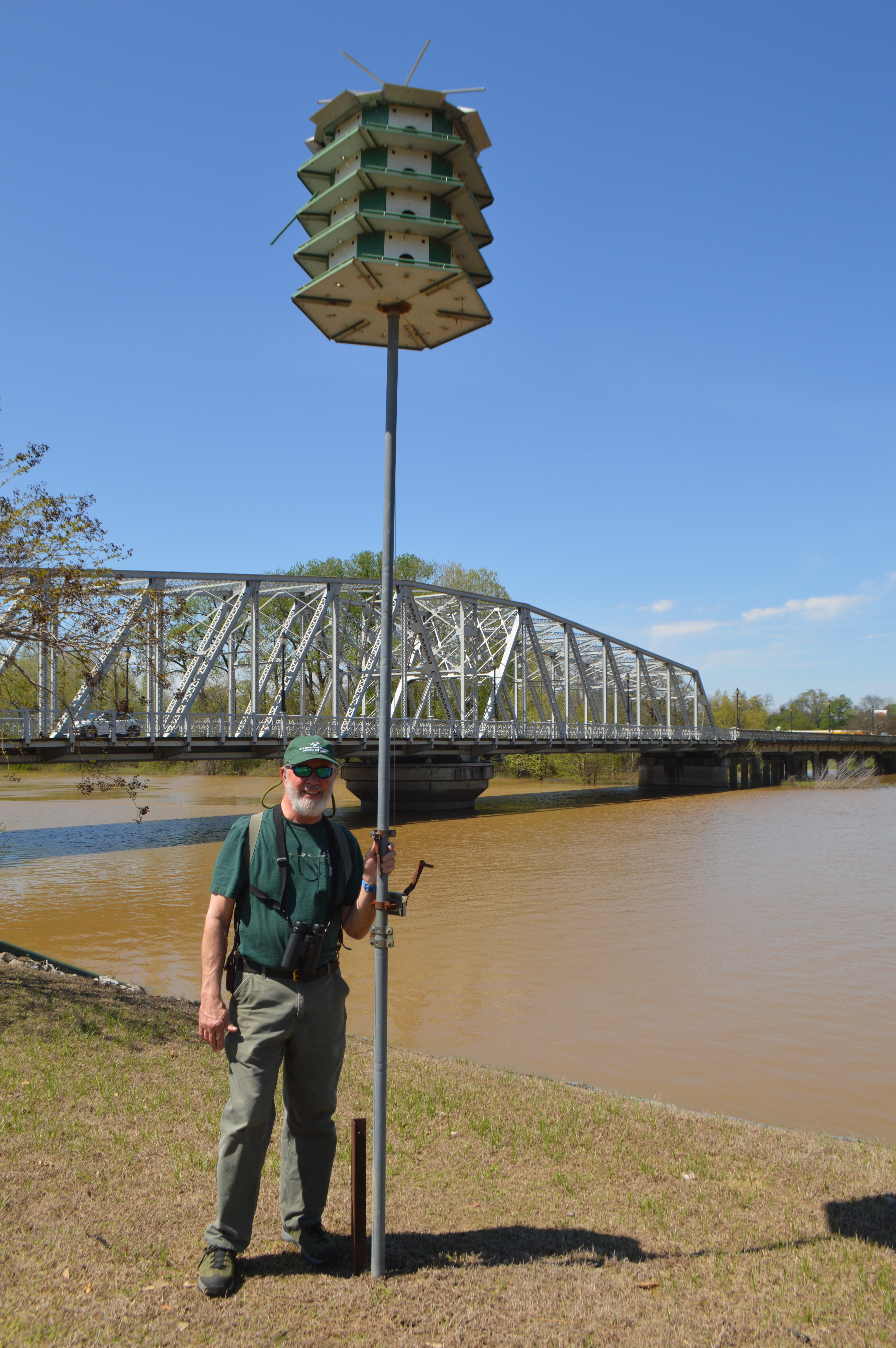 Philip Barbour stands by one of the six purple martin houses in Greenwood that his sons built more than 20 years ago as Eagle Scout projects.
“These birds, the martin, are very vocal,” said Philip Barbour, a recently retired wildlife biologist and botanist. “They make all these cheerful little chirps and sounds.”
The purple martin birdhouses were Eagle Scout projects by Barbour’s sons, Frank and Richard. There’s a total of six. In addition to the four on Front Street, there’s also one set up along River Road in front of Greenwood Internal Medicine Associates, and the other is located in the grassy area between the parking lots of Greenwood Leflore Hospital and the Wellness Center.
“To get your Eagle merit badge, one of the requirements is you have to complete a project before you can get your badge,” said Barbour.
The purple martin houses project began with Barbour’s older son, Frank, in 1995.
He, along with a few other fellow Scouts, constructed the bodies of three houses.
The houses, specifically designed for purple martins, are made out of aluminum and came in kits with hundreds of parts.
“It took them eight hours per house to assemble. It was a pretty lengthy project, and then they had to actually put them up,” said Barbour.
The location they choose for the first three houses was the south side of the river bank, right across from the Viking Range headquarters and Regions Bank.
The next set of houses were built a few years later by Barbour’s second son, Richard, also as an Eagle Scout project. One of those houses is set up on Front Street by the first three, and the other two are on River Road and by the hospital.
The houses have held up well over the years, and Barbour said people have told him how much they enjoy the birdhouses and seeing the purple martins each year.
“They enjoy watching the martins come back,” he said.
A migratory bird, the purple martins have been back in Greenwood for about a month now.
Barbour called the birds “summer residents.” The ones that nest in Greenwood fly up from South America in the spring and stay until around the end of July.
According to the Purple Martin Conservation Association, the birds breed in North America and winter in South America. Some fly up north as far as southern parts of Canada, but are mainly found in the Southern, Midwest and Northeast regions of the United States during the summer. The birds, however, are very early spring migrant in the South.
“The birds are fascinating. They’re real interesting, and a lot of people like them,” said Barbour. “These birds that are here, they found those houses and have been coming back since the mid-1990s.”
Barbour said purple martins are very philopatric.
“These birds will find a nest box, gourds or, in this case, these houses. They find them, and if they are successful in them and raise young, those same birds will come back year after year after year to the same box,” he said. “Because of that, people establish these long-term relationships with their purple martins, and they look forward to the purple martins.”
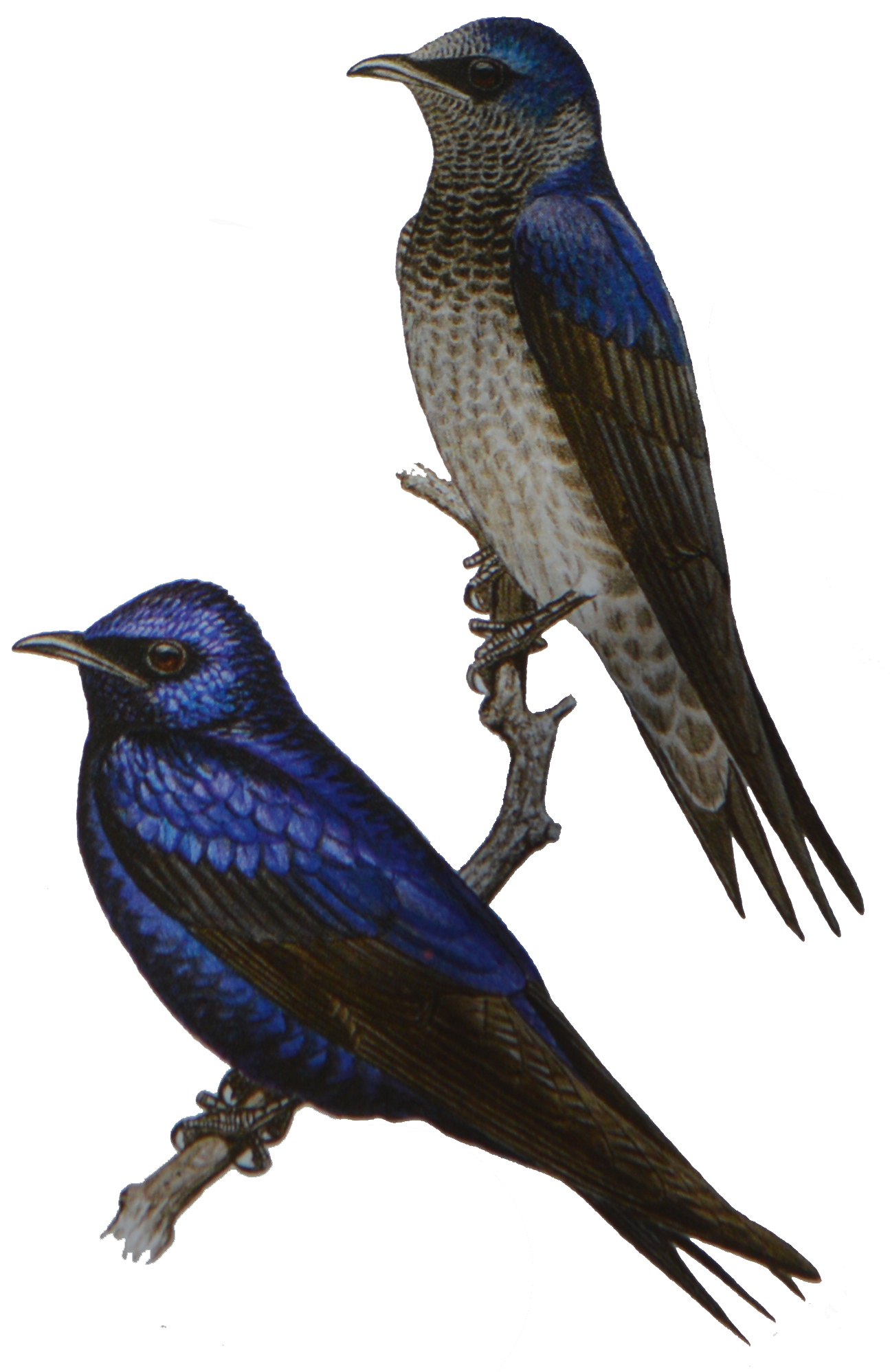 Above is a female purple martin, and below is a male purple martin.
The male purple martin is a dark, glossy purple-blue color, while the female birds are purple-blue on top and gray below. They sing loud, rich whistles or a low churr.
Purple martins are native songbirds in the swallow family. Other swallows that nest in the area are tree swallows, barn swallows, northern rough-winged swallows and cliff swallows.
The Purple Martin Conservation Association reports that, east of the Rocky Mountains, the songbirds nest almost exclusively in human-supplied housing. The birds are dependent on people for their survival.
Along with their songs, the birds are known for their aerial acrobatics, insect-eating habits and their tolerance of humans.
The association describes purple martins as aerial insectivores, consuming insects during flight. With the houses close to the Yazoo River, there’s many flying insects for them to eat. Some of their favorites include dragonflies, moths, butterflies, flies, beetles and wasps.
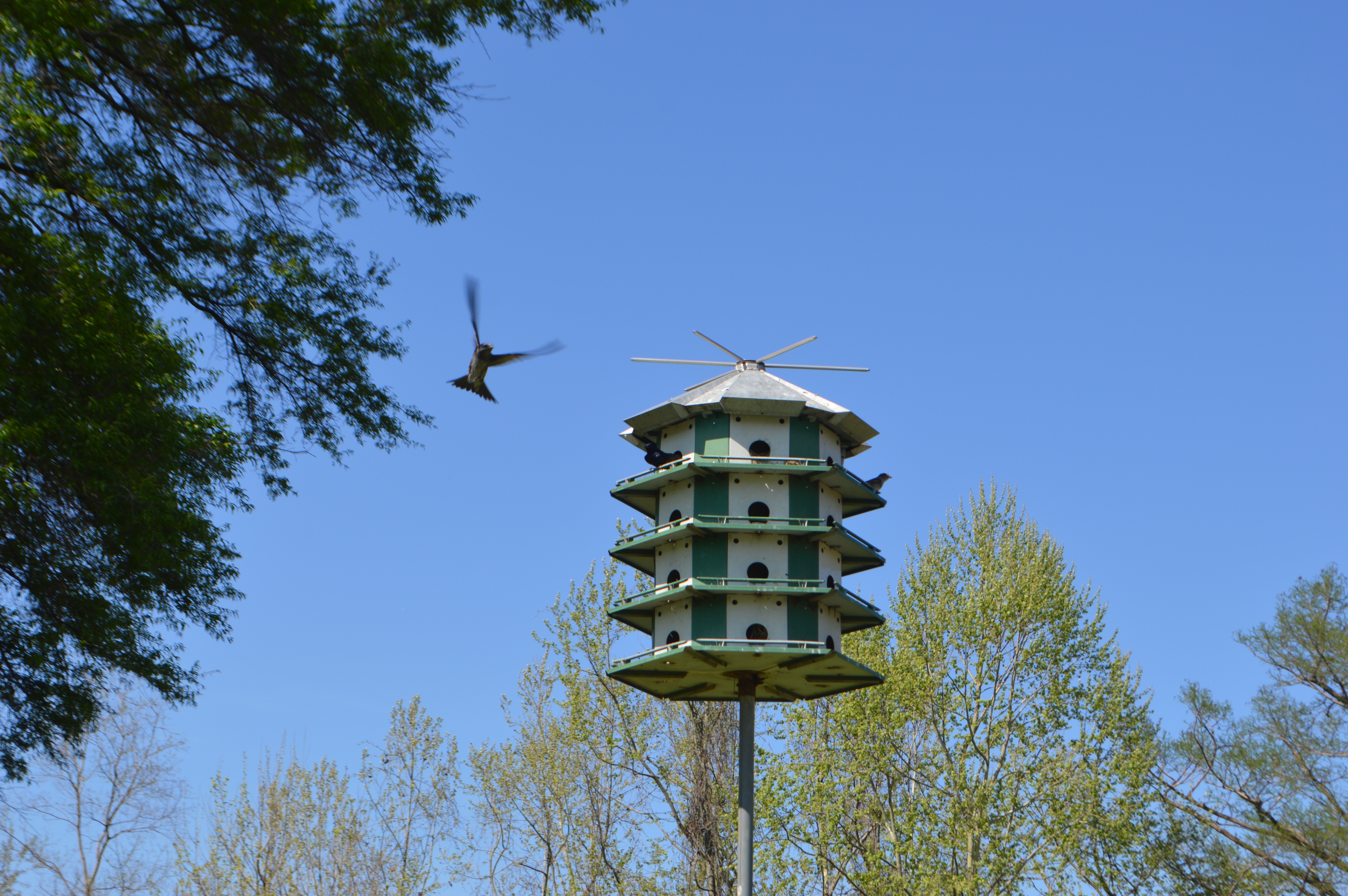 The purple martin house located in the grassy area between the parking lots of Greenwood Leflore Hospital and the Wellness Center featured many chirping birds Thursday afternoon.
“They eat insects in the air while they are flying, kind of like bats,” said Barbour.
Purple martin houses need to be set up in a clear, open area close to humans.
“They like real wide-open spaces,” said Barbour.
Another common home for purple martins is a birdhouse gourd, which is usually painted white to help keep the inside of the gourd cool in the summer.
For those who want to grow gourds to be used for purple martin homes in the future, Barbour suggests growing the gourds on the ground, rather than letting the vine climb up.
“What you want is a real thick shell, and you want the body of the shell to be real wide,” he said. “The way you do that is to let them sit on the ground, and let them get real wide and broad.
“You want a thick shell to make it strong, and the way you do that is to keep it well-watered. It needs a lot of water,” he said. “Gourds need a lot of sun, water and space.”
Those who go down by the river on Front Street can sit and listen to the little songbirds and watch them fly over the Yazoo, catch insects and go back to the houses, with several of the homes already packed with purple martins.
“In general, those houses have been very successful,” said Barbour.
Barbour continues to check on the houses his sons built years ago. Now that he is retired, he plans to spend more time keeping up with the houses and the birds that nest in them.
He’s happy that the houses are still in good shape and that the birds come back to nest each year.
“It was not only successful for the birds, but also for the community to have an Eagle Scout project that people have been enjoying since it was put in,” he said. “It’s a win-win thing. They built the houses, so they got their Eagle badges out of that, and it’s just really awesome. People will tell you how much they enjoy watching those little birds, because they are really cheerful little birds.”
• Contact Ruthie Robison at 581-7235 or rrobison@gwcommonwealth.com.


