Ben Woodard, 33, of Carrollton, loves building things. He opened a business, Hickory Grove Wood Co., in Carrollton, for the express purpose of making things out of wood. Recently, his lifelong passion to create included refurbishing a unique piece of history: the original work desk and chair of J.Z. George, the esteemed soldier, lawyer and statesman who represented Mississippi in the U.S. Senate from 1881 until his death in 1897.
Woodard was commissioned by the Cotesworth Center’s board of directors to restore the antique walnut work desk to its original beauty. The project took about a week in January to complete. Now finished, the desk will be returned to Cotesworth, George’s family estate in North Carrollton.
“This desk was constructed around the late 1870s,” said Woodard, admiring the finished product. “It is older than the Eiffel Tower. It’s older than Coca-Cola. I don’t know that this was a once-in-a-lifetime opportunity, but I do know that something like this doesn’t come along every day.”
Woodard, who is a Louisiana native, moved to Carrollton with his wife, Lizzie, in 2021. Their two children are Wyatt, who is 6, and Clara, who is 3. Lizzie works for the Greenwood-Leflore County Chamber of Commerce. They moved to Carrollton from Cleveland, Mississippi, where Ben previously sold farm equipment and worked for a manufacturing company building seat frames for F-150 pickups. He also worked for John-Richard, a luxury home furnishings manufacturer in Greenwood. On relocating to Carrollton, he decided to start his own full-time business making fine furniture.
“Fine furniture doesn’t really have any metal parts,” he said. “It uses proper joints to join the wood. It’s gonna have dovetails, no metal fasteners. It’s hand-crafted and more time-consuming. Most of my projects are just going to be wood and glue.”
Woodard’s love for handmade objects started at a young age with his father. “Dad worked in the oil fields for Exxon-Mobil,” he said. “He was a maintenance manager, very hands-on, and he was always making something. I’ve been making stuff with my dad since I was 12 or so.”
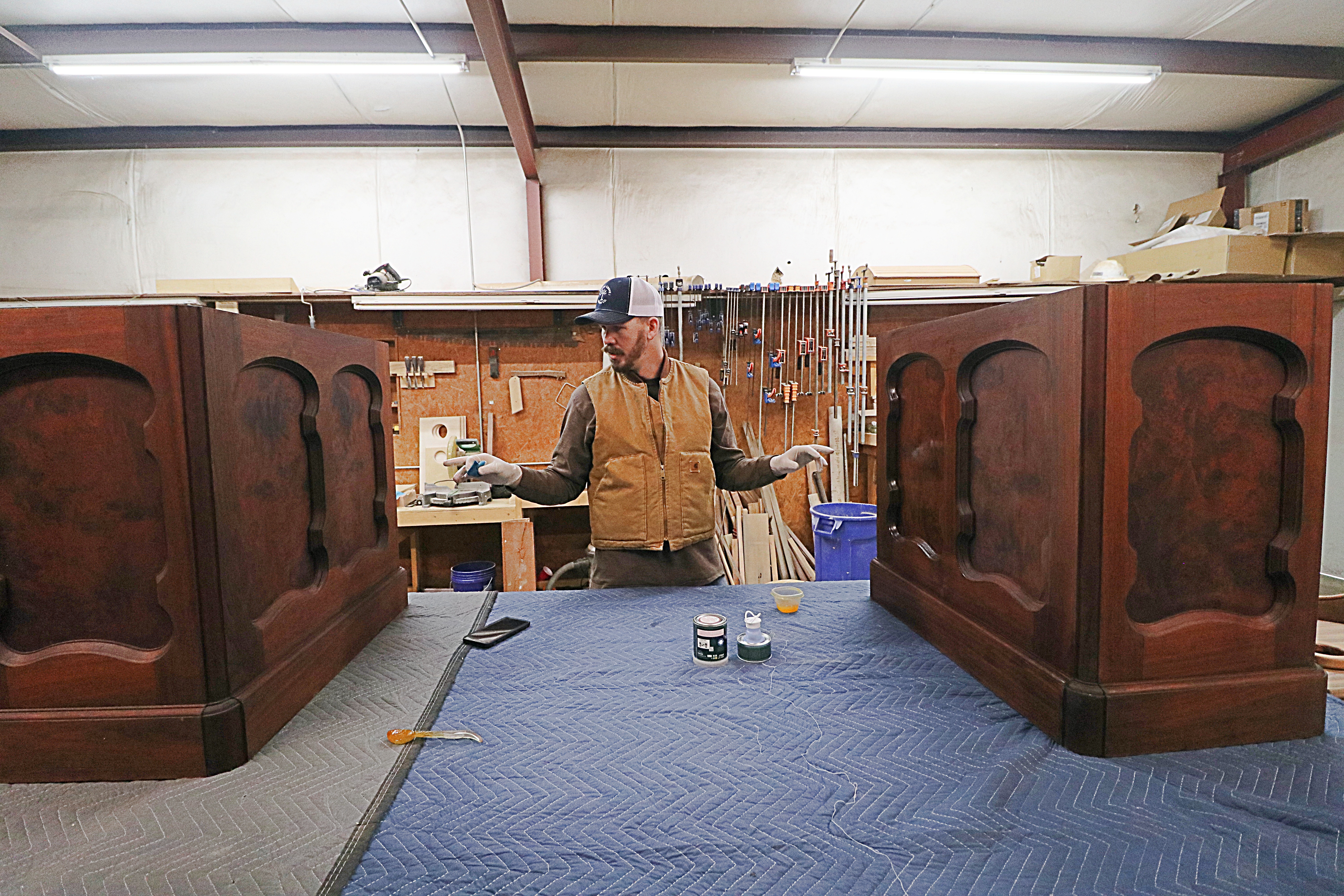 Ben Woodard explains his process of disassembling J.Z. George’s desk into its separate components and refinishing them in his Carrollton shop. By taking the furniture apart, he could learn more about how the unknown craftsmen built it sometime in the late 1870s. (By Dan Marsh
He graduated from Louisiana Tech in Ruston with a degree in agriculture business and earned his MBA from Mississippi State. He left John-Richard in August of last year to start his own furniture company.
“I had been making furniture on the side,” he said, “but when we moved to Carrollton, it felt like it was the right time to make the leap.”
Woodard’s interest in building home furniture began out of necessity. “Lizzie wanted a hutch,” he said, “but we didn’t have the money, so I made one and that sparked the journey.”
His main product is custom furniture — tables, dressers, nightstands, living room furniture. “It’s just taken off,” he said of his business. “The people we bought our house from referred us to some clients in Carrollton and I did my first full refinish for them. Refinishing wasn’t really in the plan, it just happened.”
He recently refinished an antique pie cabinet. “I took all the paint off, stripped it to the bare wood, and went back with a stain and finish, taking out all the scuffs and dings,” he said. It was a process he would soon apply to J.Z. George’s historic work desk.
His experience in furniture manufacturing and as a craftsman helped him to “not feel nervous at all” about taking on the task.
“I had that background, I understand how it’s constructed. Having that understanding is the foundation for any restoration,” he said.
He first learned about the project in November when Kenny Downs, chair of the Cotesworth board, posted on social media seeking someone to do the job. “I reached out to Mr. Downs, and we talked about it. We talked about how the desk would look, how they wanted it done. It was a long conversation. I’d say it took over a month before we decided to do something and pull the trigger.”
He made the decision to take on the project “right at Christmas,” and brought the desk to his 1,800 square-foot shop last month. His instructions were to “keep it as close to the original as possible,” he said. “This is walnut construction with poplar in the drawer boxes. It’s as well-made a desk as you’ll ever see. They spared no expense when they made it. They used only the finest materials, long before there was such a thing as power tools.”
His first task was cleaning up the desk. “It was rough,” he said. “A lot of scratches and dings. I knew there were some issues with the desktop veneer, which I thought I might not be able to restore. I knew that once I got the finish off I would have to play it by ear as far as keeping it to the original.”
Woodard knows nothing about the desk’s builders. “They left no maker’s mark,” he said. “They were just humble craftsmen. The work speaks for itself.”
However, his preference for disassembling furniture helps him understand the process better. “It’s almost as good as getting to meet the builder and ask questions. When you take it apart, you can see what the builder was trying to do and how it was accomplished. I tell people that I know a piece of their furniture better than they do because I’ve stripped it down to its bare components. I know what it was meant to do and, more importantly, what it was not meant to do.”
Disassembly came after Woodard cleaned up the desk and photographed it. “That’s when I dove into the construction,” he said. “To see how it was built. The more you can get into flat pieces, the better everything turns out. It was built to come apart.”
However, there were a few surprises along the way. “All the screws are flatheads,” Woodard said. “You could tell that the grooves were not meant for modern flathead screwdrivers. They were real shallow and I had to be careful. I broke two of my flathead bits, those screws were so tough. I never break a screwdriver bit! That was something I hadn’t anticipated.”
He also noticed that a small piece of the desk appeared broken. “It was missing,” he said. “I knew I would have to reconstruct it. I have all these modern tools and a big stock of walnut, so I knew I could do it.”
(The restored piece looks identical to the rest of the desk — or, it does to the layperson.)
He placed the desk upside down on his assembly table and began breaking it down. “I got the top off and all the drawers out,” he said. “I was able to take the panels off, all the runners the drawers sit on. That left this empty carcass with window holes in it.”
The process of “making everything flat” took him about half a day.
“I was really nervous about working on the desktop,” he said. “With a veneer, you never know how thick or thin it is. If you use a power sander and you sand through the veneer, then you’ve ruined it. That wasn’t an option, so I hand-scraped the top. I didn’t use a terrible amount of power tools.”
He pointed out the desk trim. “It’s perfect, but the only way to do it perfectly by today’s standard is to use a router — but that wasn’t invented yet,” he explained. “It had to be some sort of hand plane with a specific edge profile. I want to learn those techniques. The quickest way to ruin one of these projects is to use a router or some sort of power tool. Hand tools are much more enjoyable.”
Once he had the desk as well as its matching swivel chair in separate pieces, he put in eight to 10 hours per day on the project for a week. “I made sure I was taking my time and not tearing anything up.”
He hand-rubbed the finish, something he said he does not ordinarily do. “I’d rather spray it, but you get a better finish if you use a hard wax oil and hand rub it. I was definitely trying to do my best to get it back to its original state. That guiding thought was what made me think about the original builders so much. I wondered what they would think of it now.”
Part of the desk’s elaborate design is its locking system for the drawers. “Being a senator, George had to have all of his documents secure,” Woodard speculated, “and so its locking system is fairly intricate, especially for the time.”
The desk has nine drawers. Each has a lock with its own recesses cut into the back of the drawer face and one in the top for the locking bar. “Just cutting out the mortices for the locks would take me half a day or better, and that’s with power tools,” he said. “There’s no telling how long it took them to build the locking system. And the precision is accurate.”
Woodard said not much is actually known about the desk, but that he thinks George probably ordered it to his specifications. “Far and away, even for today, they used the nicest materials. I’m sure he told them not to hold back, and they didn’t.”
The chair that accompanied the work desk was also in rough condition. “It swivels,” he said, demonstrating the restored piece. “The top piece that supports the base was broken in half. I had to take it apart and recreate some pieces to make it structurally sound. I did not do the upholstery, I have a friend who does that, but it is period-specific.”
Woodard finished the work on a Friday night. “We will deliver the desk back to Cotesworth,” he said. “We’ll be a lot more careful moving it back in — it’ll be wrapped in bubble wrap!”
He admired the fully-restored desk. “I feel like I want to keep it!” he laughed. “Not all projects are fun, but this was a blast. It was of the utmost importance to get all the details right.”
He said he wants to have a conversation with the desk’s owners to make sure they understand the techniques that went into making it. “It’s more than a piece of furniture,” he said. “It tells a story.”
***
Dr. Gloria Kellum of Oxford is the great-great-granddaughter of J.Z. George. She is able to trace ownership of the desk from its original place in George’s Senate office to the present. She is excited about Woodard’s restoration.
“I know that (Woodard) was delighted to get to work on the desk,” she said. “He said it was the prettiest wood he had ever seen.”
The desk as well as its chair, letter box and blotter became an heirloom after George’s death in 1897. Upon his death, it was sent to his son-in-law, William Hayne Leavell (1850-1930). In 1874, Leavell married Mary George (1854-1919), J.Z. and his wife Bettie’s daughter. They lived in Houston, Texas, where he was pastor of the First Presbyterian Church for 30 years. Leavell also served as the American ambassador to Guatemala.
After Leavell’s death, the furniture went to his first son James George Leavell (1873-1937), who gave the desk to his brother Seldon Leavell (1880-1936), who was an attorney. His wife, Ruth, used the desk and then arranged in her will to send the desk to the Rev. Robert John Dodwell (1934-1998), an Episcopal priest in New Orleans. Dodwell was J.Z. George’s great-great-grandson.
Ruth told her husband that she thought the desk should go back to a family clergy person since it came to them from William Leavell, a Presbyterian minister.
Bob Dodwell left the J.Z. George desk to his sister, Dr. Kellum, in 1999. She and her husband, Jerry (1942-2021), used the desk until 2021. The Kellum family then provided the desk on a permanent loan to the Cotesworth Center to be placed in Cotesworth for visitors to enjoy.
“It has a long history in our family,” she said of the furniture. “I stipulated upon giving the desk to Cotesworth that we’d like to have it restored. I told the Cotesworth board that I would support having it renovated if they could help us find somebody.”
She said Downs and Woodard made contact and that both of them got in touch with her about how to proceed.
The origins of the desk remain something of a mystery to Kellum.
“We actually have not been able to verify where the desk was used in the Senate,” she said. “I would say that the desk was built sometime in the late 1870s. When J.Z. went to the Senate in 1881, my understanding is that’s when the desk would have been built.”
She said there is no indication of where or when the desk was made or by whom. “I’m assuming he wanted it made,” she said. “I think it was made somewhere in the northeast — many pieces used in the Senate during that time were made in Connecticut and that area. I’ve not been able to verify that, but that’s what’s been said.”
Kellum, who was on the faculty at the University of Mississippi until her retirement in 2009, said it is important to preserve history and learn from it.
Though revered for his accomplishments as a lawyer, writer, politician, and military officer, J.Z. George’s legacy has been tarnished by his connection to segregation and disenfranchisement of Blacks. As a member of the Mississippi Secession Convention, George signed the Secession Ordinance. He campaigned in Mississippi for a constitutional convention in order to legally disenfranchise Blacks. He was a major figure during the Mississippi Constitutional Convention of 1890, promoting the disenfranchisement of Blacks. According to a database compiled by The Washington Post, George was among the many U.S. Congressmen who owned slaves.
“A lot of people vehemently object to honoring someone who believed in slavery,” Kellum said. “I am very aware that he was a controversial figure, and I disagree with his politics. I am also aware that you have to learn from that. History should be taught about the good, and justice should be what we all aspire to. Not everybody aspired to justice. We have to learn from the past, we can’t erase it.”
She noted that her ancestor was a statesman, a justice of the state Supreme Court, a U.S. senator, and the curator of an impressive library at Cotesworth, among many other accomplishments that affect American life today. George’s desk will “go back to its origins and contribute to people learning and understanding history. I’m sure that it will exceed my expectations.”
Contact Dan Marsh at 662-581-7235 or dmarsh@gwcommonwealth.com.


